
The Overwhelm Homeowners Face When Planning Major Renovations
Deciding to remodel your home is exciting. Actually managing that remodel often becomes exhausting. Between contractor calls, design decisions, budget surprises, and timeline delays, many homeowners find themselves stressed before work even begins. After 30+ years of managing renovations throughout Charleston and Mount Pleasant, we’ve learned what separates smooth projects from chaotic ones. It comes down to clarity, communication, and structure from day one.
We’ve built our reputation on a straightforward approach: a three-step remodel project planning process that removes guesswork and keeps your renovation on track. Whether you’re updating a kitchen, adding a bathroom, or expanding your entire home, this framework ensures you know exactly what to expect and when.
Most homeowners enter a remodel without a clear roadmap. You might have a vague sense that you want “something different,” but translating that into actionable plans, budgets, and timelines feels impossible. We hear this repeatedly from clients in our area.
The typical scenario looks like this: You get three contractor quotes that vary wildly in scope and price. One contractor mentions things the others don’t. Another timeline estimate seems unrealistic compared to the others. You’re unsure whether to trust anyone, and you lack the expertise to evaluate their assumptions. Meanwhile, you’re juggling Pinterest inspiration, magazine clippings, and half-formed ideas about what you actually want.
On top of that, you’re weighing the emotional factor. Your home is your sanctuary. The thought of strangers tearing through it for months creates real anxiety. You worry about dust invading every corner, about unexpected problems surfacing mid-project, about costs spiraling out of control, and about whether the final result will match your vision.
The financial uncertainty is particularly stressful. Without a detailed plan upfront, hidden costs lurk around every corner. A contractor discovers rotted framing. Your new plumbing needs rerouting. Materials cost more than anticipated. Suddenly your $50,000 project becomes $65,000, and you’re trapped mid-renovation with no good options.
What homeowners really need: A partner who manages complexity so you don’t have to shoulder it alone.
Why Traditional Remodeling Often Goes Wrong
Most remodeling projects suffer from a fundamental problem: design and construction happen separately. An architect sketches pretty plans without understanding construction reality. A contractor builds those plans without buying into the design intent. Communication happens sporadically. Problems surface late, when they’re most expensive to fix.
This separation creates several predictable failures:
Vague specifications lead to misunderstandings. A contractor interprets “high-end finishes” one way; you interpret it another. Neither interpretation is documented. When work begins, disappointment follows.
Budget and timeline estimates lack grounding. Without detailed specifications, no one truly knows what materials cost or how long work takes. Early estimates are educated guesses. As the project progresses, reality sets in, and budgets balloon.
Design changes become expensive change orders. You decide mid-project that you want different tile, or you discover that your original plan won’t work with existing structural elements. Late changes cost significantly more than decisions made upfront.
Homeowners feel out of control. You’re calling for updates. The contractor is unavailable. You hear rumors about problems from your neighbor instead of directly from your contractor. Trust erodes.
Quality suffers when no one’s accountable for the whole picture. The architect isn’t responsible for construction quality. The contractor isn’t responsible for whether the design works. Problems slip through cracks.
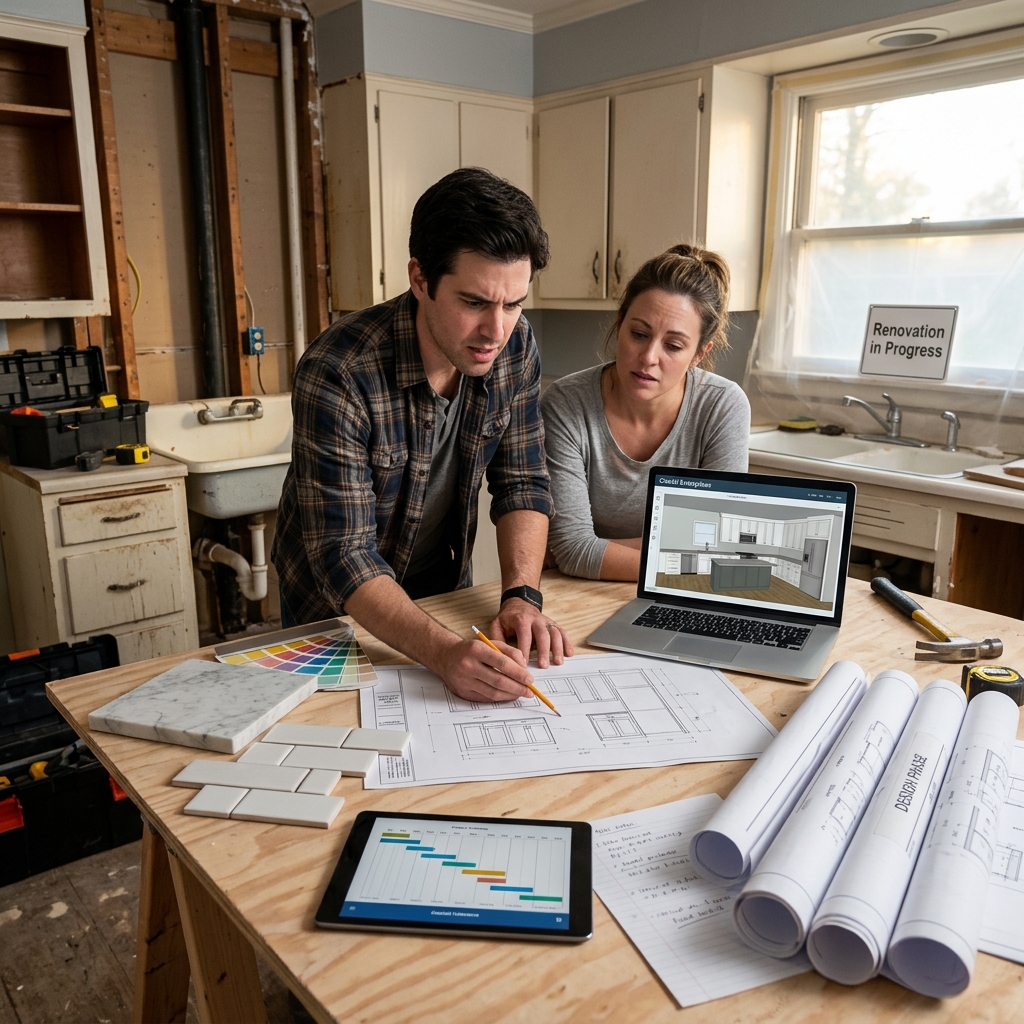
After decades in this industry, we’ve seen how these breakdowns happen. We’ve also learned exactly how to prevent them.
Our Proven Three-Step Project Planning Process: Design, Build, Deliver
We approach every project as a unified effort, not a series of disconnected stages. Our design-build remodel philosophy means our designers, builders, and project managers work together from the start. That alignment saves you time, money, and stress.
Our three-step framework is straightforward:
- Design: Collaborate with you to understand your needs, explore solutions, and create detailed plans everyone can trust.
- Build: Execute those plans with transparency, clear communication, and proactive problem-solving.
- Deliver: Hand over a finished project that exceeds your expectations and stands the test of time.
Each step builds on the last. Decisions made during design prevent problems during build. Clear communication during build means no surprises at delivery. Let’s walk through each phase.
Step One: Collaborative Design and Discovery
This is where we invest time understanding your vision, your lifestyle, and your home’s unique constraints. We don’t rush this phase. A thorough design phase prevents expensive mistakes later.
We start with a detailed consultation. We visit your home and listen carefully to what matters to you. Maybe you spend your mornings in the kitchen and want natural light flooding the space. Perhaps you’re considering aging in place and need accessibility features built in. You might have a historic home with charm you want to preserve while adding modern functionality. We ask detailed questions and take extensive notes.
Next, we develop a preliminary scope of work that addresses structural, mechanical, electrical, and design considerations. We show you options and explain trade-offs. Choosing between two cabinet styles is straightforward; choosing between expensive custom cabinetry and quality semi-custom options requires understanding your priorities and budget.
For complex projects like additions or historic renovations, we obtain necessary permits and conduct detailed site surveys. We identify potential complications early. Updating a 1940s bathroom often means discovering outdated electrical capacity or plumbing that needs rerouting. We’d rather know this during design when solutions are inexpensive than discover it during construction.
We develop detailed 3D renderings and specifications so you can visualize the finished space. This isn’t artistic sketching; these are accurate representations showing exactly what your kitchen, bathroom, or addition will look like. You’re not imagining possibilities; you’re seeing reality.
Once design is locked, we create a detailed project estimate and timeline. You see exactly what work will happen, in what sequence, and what it costs. There are no hidden line items or vague categories. If unforeseen conditions arise during construction, we’ll discuss them with you immediately, but the upfront estimate is accurate based on the specifications we developed together.
Your action: Schedule a consultation with your remodeling partner early. Invest time in the design phase, ask detailed questions about how options affect cost and timeline, and ensure you receive detailed written specifications before construction begins.
Step Two: Transparent Build Execution and Communication
With solid design and specifications in place, construction becomes predictable. Our team knows what we’re building, why we’re building it that way, and how long it should take.
We assign a dedicated project manager to your renovation. This person is your single point of contact. You call or text them with questions or concerns. They coordinate all trades, manage the schedule, solve problems, and keep you informed. No more wondering who to call or waiting for callbacks.
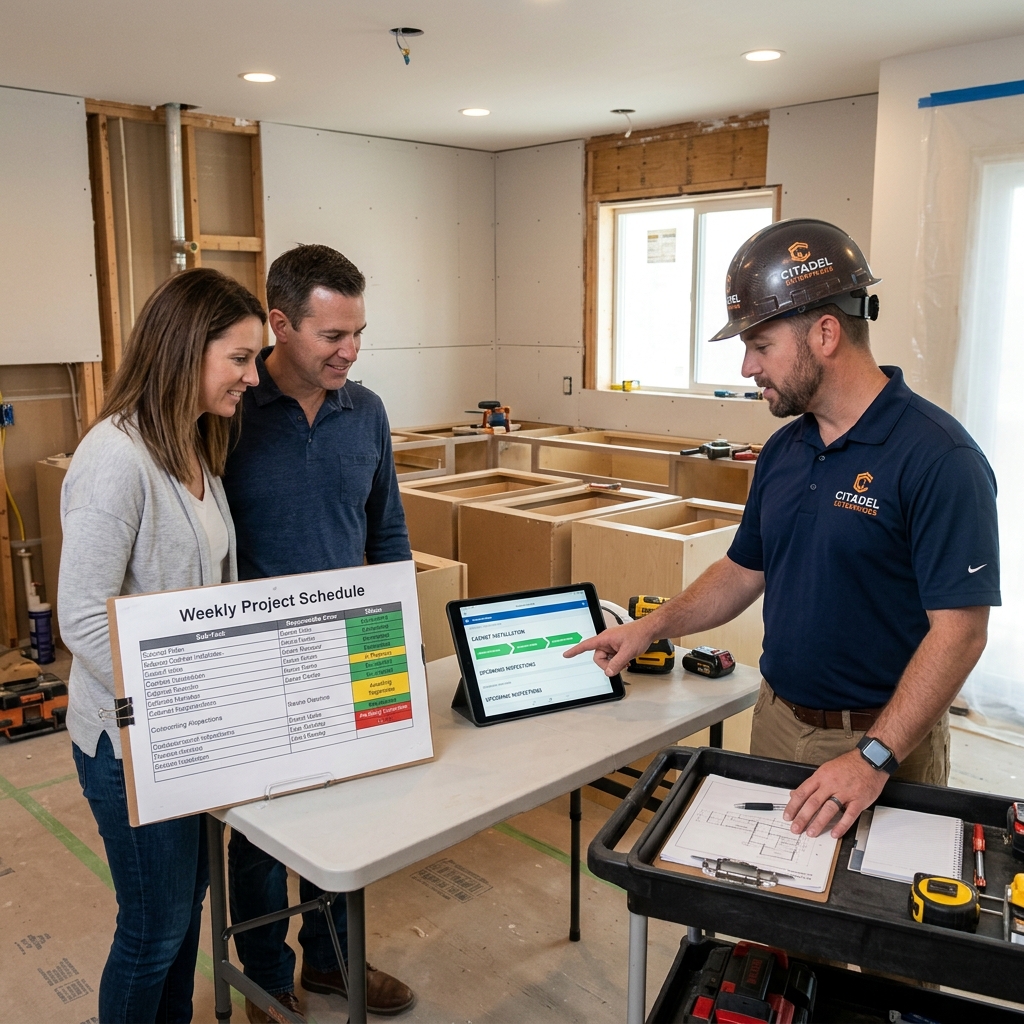
We maintain a detailed schedule that specifies which work happens each week. Your kitchen renovation might progress like this: Week 1-2 covers permits and rough demolition. Week 3 addresses structural work and mechanical rough-ins. Week 4 includes framing and electrical rough-ins. Weeks 5-6 cover drywall and flooring prep. Weeks 7-8 involve finishing work, cabinet installation, and tile. Week 9 includes final systems, paint, and fixtures. Week 10 is final inspection and your walkthrough.
That schedule is shared with you upfront. If delays occur (bad weather, supply chain issues), we update the schedule and communicate immediately. You’re never surprised.
Communication happens regularly. We send weekly updates. If problems arise, we explain what we found, what it means, and what we recommend. For example: “During demo, we discovered that the wall between your kitchen and dining room has a load-bearing header that will need replacement. This adds $3,000 to the budget and extends the timeline by two weeks. Here’s why [explanation]. Here’s what it means for your project.”
We photograph and document your home before work begins. We maintain photographic records throughout construction. Our team respects your home. We protect flooring, hang dust barriers, and manage debris responsibly. Your home is a construction site, but it’s still your home.
Quality control happens continuously. Our team inspects work daily. We don’t wait until a phase is complete to discover problems. We catch issues immediately, when they’re easy to address.
Your action: Ask your contractor about their communication process. How often will you receive updates? Who is your primary contact? Will you see progress photos? How will they notify you of changes or problems? Clear answers to these questions indicate a professional who values transparency.
Step Three: Quality Delivery and Ongoing Support
As the project nears completion, we shift focus to final details. Our team walks through the space methodically, checking every tile, every cabinet hinge, every paint edge, every fixture installation. We create a punch list of minor items needing attention. These are addressed before you do a final walkthrough.
That final walkthrough is important. We walk through the space together. You see the finished result. We explain any decisions made during construction and answer your questions. By this point, there shouldn’t be surprises. You’ve been involved throughout the process and understand what was built and why.
We handle all final inspections and approvals. We ensure the project meets all code requirements and passes municipal inspection if applicable.
After you move in, we stay available. We provide detailed care and maintenance instructions for your new systems. We’re here if questions arise during your first months in the renovated space. We handle any warranty items that emerge. Your relationship with us doesn’t end at project completion.
For ongoing maintenance, we’re available for future updates and repairs. Many clients who’ve worked with us once call us again years later when they’re ready for their next project. That speaks to the relationships we build.
Your action: Choose a contractor who views project completion as a beginning, not an ending. Ask about their warranty period, their availability for follow-up questions, and their approach to ongoing maintenance.
How Our Process Saves You Time and Money
Our three-step approach delivers measurable financial and time benefits compared to traditional remodeling.
Better budgets, fewer surprises. Because we develop detailed specifications during design, our estimates are accurate. We’re not guessing about material costs or labor hours. Our 30 years of local experience means we understand what things actually cost in the Charleston area. We also identify potential complications during design rather than discovering them during construction. A $500 design-phase decision prevents a $5,000 construction-phase problem.
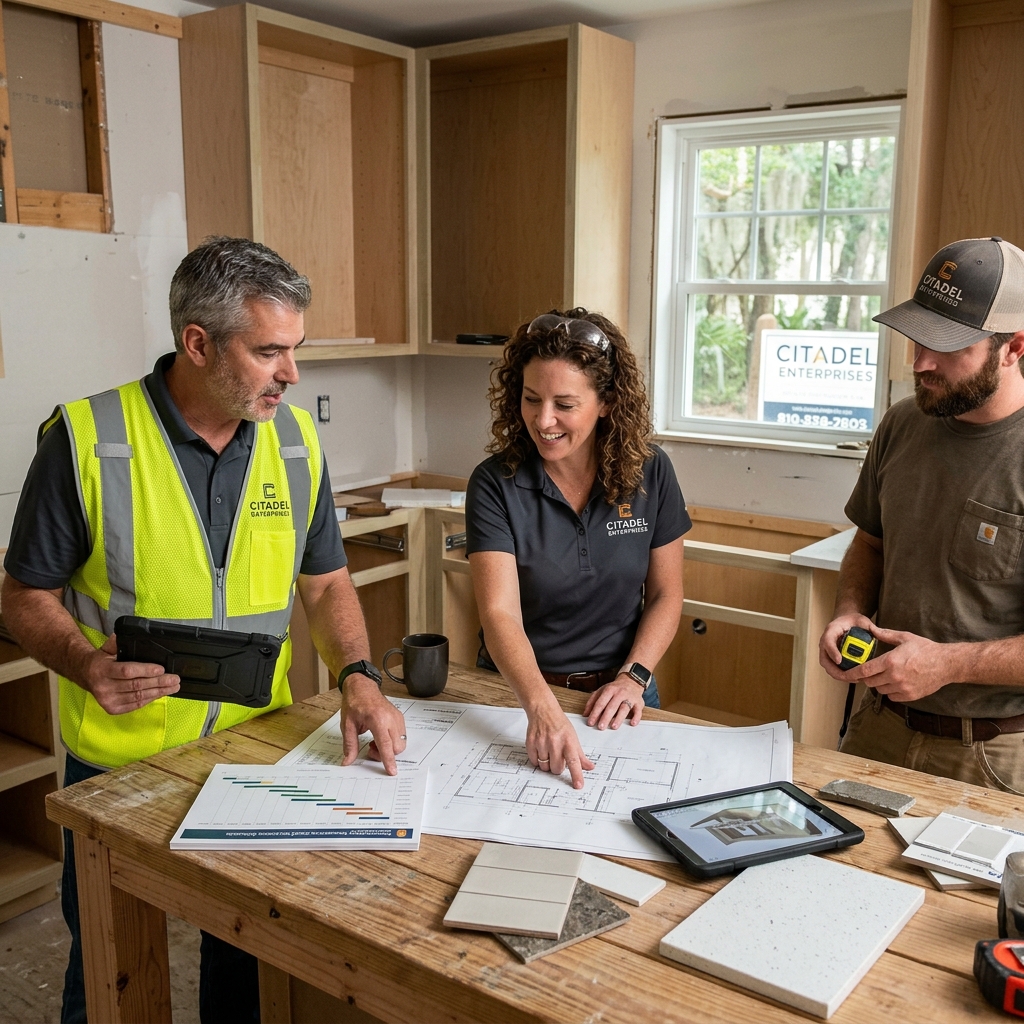
Efficient scheduling reduces project duration. We don’t start building until design is finished. We don’t discover mid-project that we need to reorder materials or wait for special items. Detailed specifications mean our suppliers have everything on hand when needed. Our coordinated team ensures different trades don’t step on each other’s work. Projects run faster because fewer delays interrupt progress.
Fewer change orders mean cost stability. Because you’ve approved detailed specifications upfront, we’re not constantly asking for approval on decisions. Changes still happen occasionally (genuine unforeseen conditions, your changing preferences), but they’re the exception rather than the rule. You’re not paying premium prices for change-order work.
Quality work costs less long-term. A bathroom that’s properly waterproofed and carefully installed costs less to maintain. A kitchen with quality cabinetry and correct installation stands up better over time. Good workmanship prevents problems. You’re not cutting costs during construction only to pay twice as much for repairs later.
Consider a specific example: A homeowner wanted a kitchen update. A traditional contractor quoted $60,000 with a six-month timeline. During our design phase, we discovered that the existing plumbing and electrical layout wasn’t optimal for the desired kitchen layout. A modest rerouting added $4,000 to the cost but prevented much larger problems later and created a better final layout. Our estimate was $62,000 with a four-month timeline. The project finished on schedule and on budget. The homeowner paid slightly more upfront but saved both time and frustration, and got a better result.
Your action: Get detailed written estimates that break down costs and specify exactly what’s included. Compare not just total price but scope of work. A lower bid that omits items is more expensive than a higher bid that’s complete.
Why Charleston Area Homeowners Trust Our Approach
Our roots run deep in Mount Pleasant and Charleston. We’ve been serving this community for over three decades. Many of our current clients are homeowners whose parents or grandparents we’ve worked with previously. That generational trust doesn’t happen by accident.
We understand the Charleston area specifically. We know the local building codes. We understand common issues in older homes throughout the region (plumbing limitations, outdated electrical systems, foundation considerations in our climate). We have relationships with local suppliers, trades, and inspectors. We know which materials hold up best in our humid climate and which ones deteriorate. This local expertise saves you time and money.
Our work is visible throughout the area. If you’ve admired a remodeled home in Mount Pleasant or Charleston, there’s a reasonable chance we worked on it. We’re proud of the homes we’ve touched and the families we’ve served.
Most importantly, we approach every project as if we’re working on our own home. We care about your satisfaction because your satisfaction is our reputation. In a close-knit community, that matters deeply.
We’re also committed to professionalism. Our team is licensed, insured, and bonded. We carry appropriate insurance for both our liability and workers’ compensation. We maintain permits and follow all code requirements. Shortcuts exist in this industry, but we don’t take them.
Getting Started With Your Remodel Today
If you’re ready to explore a kitchen renovation, bathroom update, historic home restoration, or whole-house addition, the first step is a consultation. We’ll visit your home, listen to your vision, and discuss your timeline and budget. There’s no obligation and no high-pressure sales pitch.
During that conversation, we’ll explain our three-step process specifically as it applies to your project. We’ll answer your questions and help you understand what’s involved.
If you’d like to move forward, we’ll provide a detailed proposal that outlines the design phase, the estimated construction timeline, and the projected cost. You’ll know exactly what to expect before committing to the project.
Our remodeling services include kitchen and bathroom renovations, whole-house additions, historic home restorations, and ongoing property maintenance. Whatever your project, our proven approach brings clarity and confidence to the process.
Reach out to us at Citadel Enterprises Remodeling. We’re here to make your remodel straightforward, professional, and genuinely stress-free.