
Before you can even begin to think about the numbers, you have to get crystal clear on what you actually want to do. The best, most realistic budgets are always built on a detailed plan that carefully separates your absolute needs from your nice-to-have wants. This is the single most important step for preventing scope creep and making sure every dollar has a job..
Translating Your Renovation Dream Into A Plan

Every great renovation starts with a vision, not a sledgehammer. Before you can attach a price tag to anything, you have to turn vague ideas like “a better kitchen” into a specific, tangible scope of work. Think of this as the foundation of your entire financial plan.
Without this clarity, you’re setting yourself up for a string of expensive changes and additions down the road. A detailed project brief becomes your North Star, guiding every decision and keeping conversations with your design-build team focused. It’s what separates a project that feels under control from one that quickly spirals.
Distinguishing Needs from Wants
Honestly, one of the most powerful budgeting exercises you can do is sit down and separate your non-negotiable needs from your “would be nice to have” wants. This isn’t about giving up on your dream space; it’s about prioritizing what matters most.
- A “need” is something that solves a real problem with your home’s function, safety, or structure. Maybe your growing family literally can’t fit in the kitchen anymore, or you have old, corroded plumbing that’s a ticking time bomb.
- A “want” is more about aesthetics or luxury. This could be that specific slab of Italian marble you saw online, a top-of-the-line appliance package, or fully custom cabinetry when great-looking stock options would do the job.
Make two separate lists. This simple exercise gives you instant clarity on where your money must go versus where it could go if the budget has room. It’s your best defense against overspending.
Your project brief should be a living document that outlines everything—from the big-picture layout changes down to the specific style of cabinet pulls you like. The more detail you can capture now, the fewer expensive surprises you’ll have to deal with later.
Creating Your Project Brief
That needs-and-wants list is the perfect starting point for a more formal project brief. This document is worth its weight in gold when you start talking to contractors. It should cover:
- Project Goals: What specific problems are you trying to solve? (e.g., “We need to increase kitchen storage and create a breakfast bar with seating for four.”)
- Inspiration: Pull together photos from magazines or Pinterest that capture the look and feel you’re going for. Make notes on what you like—the lighting, the flooring, the color scheme.
- Known Issues: Be upfront about existing problems. Is there a leaky faucet? Terrible lighting? An awkwardly placed door?
Doing this homework is more critical than ever. The U.S. home renovation market exploded by 26.6% between 2021 and 2022. While that intense growth has cooled a bit, overall spending is still around $100 billion higher than it was before the pandemic. For homeowners here in Charleston and Mount Pleasant, this means you’re working in a mature market with established professionals and clear cost benchmarks—making your initial plan all the more important.
This early planning also forces you to think about requirements beyond the build itself, like navigating local building codes. Having a well-defined scope from the start makes it much easier to understand the permitting process for home remodels in our area. Ultimately, a solid brief empowers you to have direct, productive conversations with design-build firms, ensuring everyone is on the same page from day one.
Getting a Real-World Read on Renovation Costs
Okay, you have your vision. Now comes the part where we attach real numbers to that dream. Getting accurate cost estimates is one of the most critical steps, and it’s about so much more than just finding the cheapest price. It’s about truly understanding what you’re paying for.
There’s a reason nearly half of all homeowners—47%, to be precise—blow past their renovation budget. More often than not, it’s because they started with fuzzy, unreliable numbers.
The quotes you get from a contractor aren’t static; they get sharper and more detailed as your project takes shape. Knowing the difference between an early guess and a final, locked-in proposal is crucial for keeping your budget on track and your stress levels down.
From Ballpark to Bid: Understanding the Numbers
When you first start talking to contractors, you’ll encounter a few different kinds of pricing. Each has its place in the planning process.
-
The Ballpark Figure: This is a rough, back-of-the-napkin number you might get after a quick phone call. Think of it as a gut check—is this project even in the realm of possibility? It’s helpful for initial brainstorming but it’s way too vague to build a budget around.
-
The Formal Estimate: Once a contractor has walked through your home and you’ve had a detailed conversation about your goals, they can put together a formal estimate. This document is a big step up, breaking down costs into major categories like labor and materials. It gives you a much clearer picture of what you’re looking at.
-
The Fixed-Price Proposal: This is the gold standard. A detailed, fixed-price proposal, like the ones we provide at Citadel Enterprises, is a firm commitment based on completed architectural plans and your specific material choices. It spells out everything, right down to the model number of the faucets. This is the document you can truly bank on.
Your goal is to methodically move from a vague ballpark figure to a rock-solid, fixed-price proposal. This journey from general to specific is what a professional process looks like, and it’s your best defense against surprise costs later on.
The Power of Multiple Perspectives
You’ve heard it a million times: get at least three bids. This advice is timeless for a reason. The point isn’t to pit contractors against each other in a race to the bottom. It’s about gathering intelligence.
Getting a few different proposals helps you spot the outliers. Is one bid suspiciously low? They might be cutting corners on materials, insurance, or skilled labor. Is another one sky-high? They might have misunderstood the scope of your project.
When the bids come in, fight the urge to just scan for the bottom-line number. The real story is in the details.
How to Compare Bids Like a Pro
Laying estimates side-by-side is where you start to see what each contractor is truly offering. You have to make sure you’re comparing apples to apples. One firm’s price might seem higher, but that’s because they’ve included the premium, durable materials you asked for, while another defaulted to builder-grade basics.
Dig into these key areas:
-
Material Allowances: What specific brands, quality levels, and quantities are included? If one bid lists “tile” and another specifies the exact premium porcelain you fell in love with, that explains a lot. These selections can drastically change the final price. You can dive deeper into what impacts the cost of a bathroom remodel in our guide on the topic.
-
Labor Details: Who is actually doing the work? A contractor who uses an experienced, in-house team will often have a higher labor cost than one who relies on a rotating cast of subcontractors. The quality, consistency, and communication you get are often well worth the difference.
-
The Inclusions and Exclusions: Get familiar with the fine print. Does the bid explicitly cover things like daily site cleanup, hauling away debris, and pulling permits? These “small” items aren’t small at all when they show up as unexpected charges on your final bill.
By taking the time to compare these details, you shift from simply price-shopping to selecting a true partner—one who gets your vision and has a transparent, realistic plan to make it happen.
Building Your Line-Item Renovation Budget
Alright, you’ve got your vision and a solid grasp of what things cost. Now comes the most critical part: turning those ideas and estimates into a detailed, line-item budget. This isn’t just about crunching numbers; it’s about creating the single most powerful tool you have to keep your renovation on track and avoid those dreaded budget blowouts.
Think of this document less as a restriction and more as your project’s command center. It’s a living roadmap that gives you control and clarity from demolition day to the final walkthrough.
Breaking Down The Costs
A good budget is more than just one big number. The real magic happens when you break the project down into individual pieces, assigning a cost to every single component. This granular view is what lets you see exactly where your money is going and make smart decisions along the way.
To get started, you’ll want to create clear categories for every possible expense. Here are the essential buckets we use on every project:
- Pre-Construction Costs: This covers the groundwork—think design fees, architectural drawings, engineering reports, and pulling all the necessary permits.
- Site Preparation: The messy stuff. This includes demolition, hauling away debris, and setting up temporary protections to keep the rest of your home clean and safe.
- Labor: A major chunk of the budget. It accounts for every skilled trade involved, from carpenters and electricians to plumbers and painters.
- Materials: These are the bones of the project: framing lumber, drywall, insulation, and all the other foundational elements.
- Finishes and Fixtures: This is where your style comes to life. Cabinets, countertops, flooring, tile, lighting, faucets, and appliances all fall into this exciting category.
For homeowners new to this process, it’s helpful to understand how pricing evolves from a rough idea to a firm, reliable number.
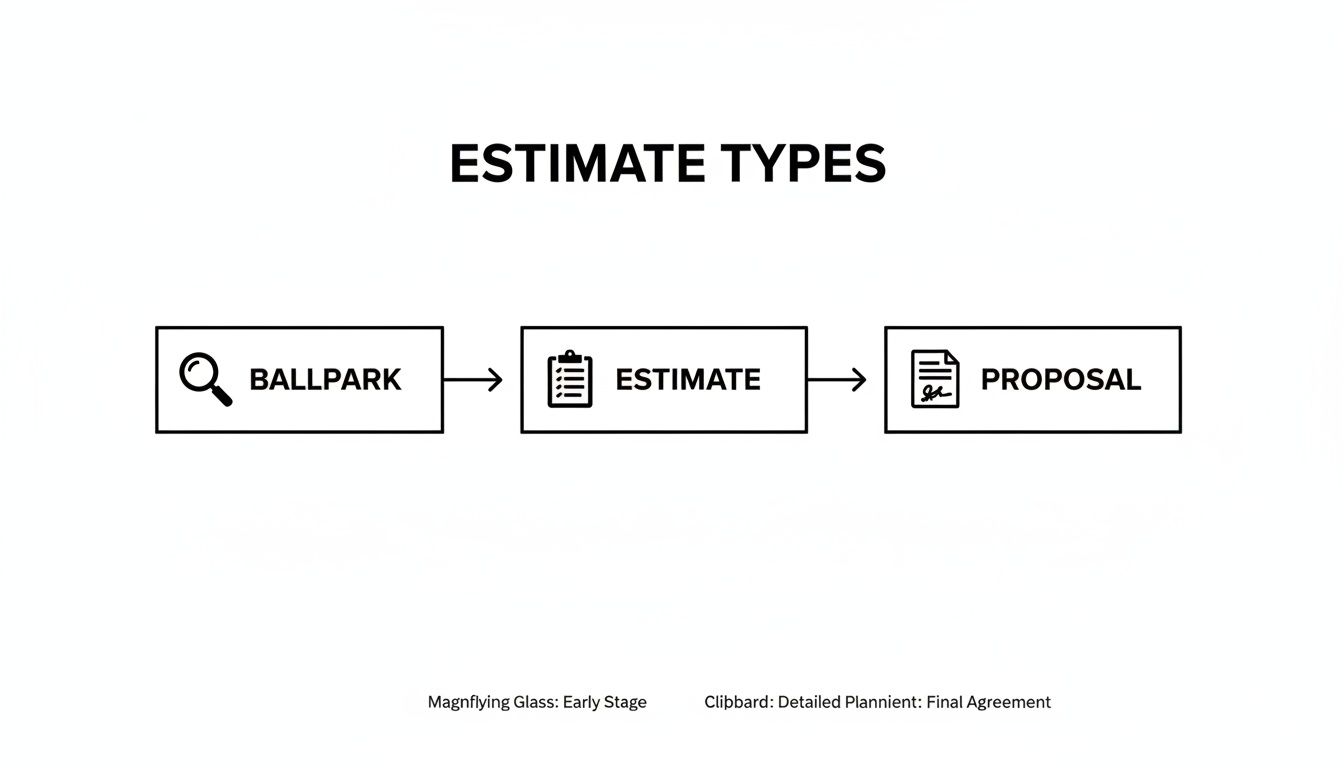
As you move from a ballpark guess to a formal proposal, the accuracy sharpens dramatically. That final, fixed-price proposal is what you’ll build your detailed budget around.
Sample Renovation Budget Breakdown
To help you visualize this, here’s a sample breakdown for a major kitchen remodel in the Charleston area. While every project is unique, this table shows a typical allocation of funds and gives you a realistic starting point for your own planning.
| Budget Category | Estimated Percentage of Total Budget | Example Cost (for a $150,000 Project) | Notes & Considerations |
|---|---|---|---|
| Design & Permitting | 5% – 10% | $7,500 – $15,000 | Includes architectural plans, engineering (if needed), and city/county permits. Essential for a well-planned project. |
| Labor | 20% – 35% | $30,000 – $52,500 | Covers all trades: carpentry, electrical, plumbing, HVAC, drywall, painting. Varies based on project complexity. |
| Cabinetry & Installation | 25% – 30% | $37,500 – $45,000 | The largest single material cost. Custom vs. semi-custom and finish level will be the main drivers here. |
| Appliances | 10% – 15% | $15,000 – $22,500 | Professional-grade appliances can easily push this percentage higher. Don’t forget ventilation. |
| Countertops | 5% – 10% | $7,500 – $15,000 | Material choice (quartz, granite, marble) and the amount of linear footage will determine the cost. |
| Finishes (Flooring, Backsplash, Lighting) | 5% – 10% | $7,500 – $15,000 | Includes tile, wood flooring, light fixtures, and hardware. These small details make a big impact on the final look. |
| Contingency Fund | 15% – 20% | $22,500 – $30,000 | Non-negotiable. This covers unforeseen issues like hidden rot, outdated wiring, or structural surprises. |
Remember, these percentages are a guide. High-end appliances or exotic countertops can shift the numbers, but this framework provides a solid foundation for building your own line-item budget.
The Non-Negotiable Contingency Fund
If I can offer one piece of advice from decades in this business, it’s this: always build in a contingency fund. This isn’t “extra” money you might spend. It’s an essential part of the budget that protects your project from the inevitable curveballs. For most renovations, a contingency of 15-20% of the total construction cost is the industry standard for a reason.
Why is it so vital? Because no matter how meticulously you plan, surprises are part of renovating. This is especially true in older homes—and we have plenty of them here in Charleston. You open up a wall and suddenly discover ancient wiring that isn’t up to code, a slow leak that has caused hidden water damage, or a structural issue that needs immediate attention.
Your contingency fund is what turns a potential crisis into a manageable problem. It’s the peace of mind that allows you to handle the unexpected without derailing your project or compromising on your vision.
Let’s say you’re doing a $100,000 kitchen remodel. A 15% contingency gives you a $15,000 safety net. You might not use every penny, but knowing it’s there is the key to a low-stress renovation. For a deeper look at allocating these kinds of funds, our guide on how to plan a budget-friendly kitchen remodeling project is a great resource.
Accounting For Market Realities
Beyond the surprises lurking in your walls, your budget needs to reflect what’s happening in the wider economy. We’ve all seen costs for both labor and materials climb recently. In fact, construction costs as a percentage of new home prices recently hit a record high, driven largely by inflation and skilled labor shortages.
This means you need to add a separate buffer for inflation—at least 4% on top of your initial estimates. This isn’t the same as your contingency fund for unforeseen problems; this is purely to cover the rising cost of doing business. On a $50,000 project, that’s another $2,000 you need to account for before you even think about what might be hiding behind the drywall.
By putting in the work to build a detailed, line-item budget that includes a robust contingency and a realistic inflation buffer, you’re no longer just a homeowner with a dream—you’re an empowered project manager, ready to bring your vision to life on time and on budget.
Finding The Right Financing For Your Project
So you’ve done the hard work and built a detailed, line-item budget. That document is more than just a plan—it’s your golden ticket for securing funding. When you walk into a bank with a solid budget, it shows lenders you’re serious and have a realistic grasp of the costs, making you a much stronger candidate for a loan.
The next step is figuring out the best way to pay for it all. Navigating the world of renovation loans can feel a little overwhelming at first, but most options come back to one powerful asset you already have: your home’s equity.
Simply put, equity is the difference between what your home is worth today and what you still owe on your mortgage. It’s the value you own outright, and it’s one of the most effective financial tools at a homeowner’s disposal.
Tapping Into Your Home Equity
Several common financial products are designed specifically to let you turn that equity into cash for your renovation. While they all draw from the same source, they work in different ways, and understanding those differences is key to picking the right one for your project.
-
Home Equity Line of Credit (HELOC): Think of a HELOC as a credit card that’s secured by your house. A lender approves you for a maximum amount, and then you can draw money from it as you need it, usually over a 5-10 year “draw period.” The best part? You only pay interest on the money you’ve actually used. This makes it incredibly flexible and a perfect fit for projects where costs might pop up unexpectedly or if you plan to tackle the renovation in phases.
-
Home Equity Loan: This is the opposite of a HELOC. Instead of a flexible credit line, you get a single lump-sum payment right at the start. You receive the entire loan amount at once and begin making fixed payments on it immediately. This is an ideal choice when you have a firm, fixed-price contract from your builder and you know the exact total cost down to the penny.
-
Cash-Out Refinance: With this option, you’re essentially replacing your current mortgage with a brand new, larger one. You then “cash out” the difference between the new loan and what you owed on the old one. A cash-out refi can be a brilliant move if today’s interest rates are lower than your current mortgage rate. You could fund your entire renovation and potentially even lower your monthly mortgage payment at the same time.
A HELOC gives you flexibility for projects with moving parts, while a home equity loan offers the stability of a fixed payment. The right choice really hinges on how you plan to pay your contractor and whether you prefer a variable or fixed interest rate.
Comparing Your Financing Options
Making the right choice here is important, as it will affect your monthly budget, the total interest you pay over the life of the loan, and your overall financial flexibility. Here’s a quick breakdown to help you compare.
| Financing Option | Best For… | Key Advantage | Key Consideration |
|---|---|---|---|
| HELOC | Phased projects or when total costs are uncertain. | Flexibility. You only borrow what you need, when you need it. | Variable interest rates mean your payment could change over time. |
| Home Equity Loan | Projects with a fixed, known cost (e.g., from a design-build proposal). | Predictability. Fixed rates and payments make budgeting simple. | You start paying interest on the full loan amount immediately. |
| Cash-Out Refinance | Large renovations when interest rates are favorable. | Can potentially lower your overall mortgage rate while funding the project. | Resets your mortgage term and involves closing costs. |
Other Funding Avenues to Consider
While borrowing against your equity is the most popular route, it’s not the only one. Depending on your situation and the scale of your project, other options might make more sense.
Personal savings, of course, is the simplest way to fund a renovation. If you’re planning a smaller update—say, a powder room refresh—using cash on hand is a great way to avoid taking on any new debt or paying interest.
For massive undertakings like a large addition or a ground-up build, you might need a construction loan. These are shorter-term loans specifically for the building process itself. The funds are typically paid out to your contractor in draws as work hits certain milestones. Once the project is complete, the loan is usually converted into a standard mortgage. A design-build partner like Citadel Enterprises can provide the detailed architectural plans and budget that lenders require to approve this kind of specialized financing.
Staying on Top of Your Budget During the Renovation

Putting together a detailed budget is a huge step, but the real work starts once the dust begins to fly. Your budget spreadsheet isn’t something you create and then file away; it’s a dynamic tool you need to live with from demolition day until the final coat of paint is dry. Diligent tracking is what keeps a project on track and prevents it from turning into a source of major financial stress.
This active oversight is your best defense against buyer’s remorse. Industry surveys consistently show that nearly half of all homeowners—an eye-watering 47%—end up blowing their budget. By keeping a close watch on your spending every single week, you can spot small issues long before they have a chance to become big, expensive problems.
Set a Rhythm for Financial Check-Ins
The most practical way to control your renovation budget is to establish a firm schedule for financial meetings with your contractor. These don’t need to be long, formal affairs; think of them as quick, mandatory check-ins every week or two. This is all about transparency and making sure everyone is on the same page.
During these meetings, you’ll go over the numbers. Your contractor should be able to walk you through exactly what’s been spent, what bills are coming up next, and how much of your contingency fund is left. This simple communication loop is your secret weapon against costly surprises.
Don’t ever hesitate to dig into the details. A true design-build partner not only expects your questions but welcomes them. Talking openly about money builds trust and keeps the project’s financial health front and center.
These meetings are also the ideal time to troubleshoot. Let’s say a specific tile is backordered, but a slightly more expensive one is available now. You can weigh the options and make a clear-headed decision on the spot, instead of getting an unexpected bill down the road.
How to Handle the Dreaded Change Order
No matter how meticulous your plan is, things change. In the construction world, a change order is the formal document that outlines any deviation from the original contract. Maybe you decide you absolutely must have those heated floors, or maybe your contractor uncovers a hidden structural issue behind a wall that has to be fixed.
The key is to have a process, not a panic attack. A proper change order isn’t just a verbal agreement; it’s a written document that clearly states:
- A specific description of the change.
- The exact cost impact, broken down by labor and materials.
- Any effect the change will have on the project timeline.
My advice? Never, ever agree to a change verbally. By insisting on a written change order, you create a natural pause. This gives you a moment to review the cost, see how it affects your overall budget, and decide if you want to pull from your contingency fund or explore another route. This one simple rule is the best way to stop “scope creep” from quietly derailing your finances.
Making Smart Decisions: Where to Splurge and Where to Save
As the project unfolds, you’ll constantly face decisions that test your budget. Learning where to invest for maximum long-term value—and where you can save a few bucks without sacrificing quality—is a skill that can make a huge difference.
Where It Really Pays to Splurge:
- The “Bones” of the House: Anything that’s difficult or expensive to change later is worth the upfront investment. Think high-quality windows, proper insulation, and the core plumbing and electrical systems. Better performance here pays you back for years in lower utility bills and peace of mind.
- High-Touch, High-Use Items: You interact with faucets, doorknobs, and countertops every single day. Opting for durable, quality materials in these high-traffic areas dramatically improves your daily experience.
Where You Can Be More Strategic:
- Decorative Lighting: You can find incredible light fixtures online that look just as good as designer brands for a fraction of the price. Plus, they’re easy to swap out in a few years if your style evolves.
- Paint: While you want a quality paint for durability, you don’t need the most expensive boutique brand to get a fantastic, long-lasting result.
- Secondary Spaces: For a guest bathroom or laundry room, you can easily opt for more cost-effective tile and fixtures without impacting your home’s overall feel or resale value.
This value-driven mindset is at the heart of how we work with clients at Citadel Enterprises. By helping you focus your money on the things that deliver the most function and joy, we make sure your new space is something you love—without the financial regret.
Answering Your Top Renovation Budget Questions
It’s completely normal to have questions, even with the most carefully planned budget. In fact, after decades of managing home renovations, we’ve found that homeowners tend to grapple with the same key uncertainties.
Getting straight answers to these common questions will give you the confidence to build a financial plan that can stand up to the realities of a major project. Let’s clear up some of the most frequent sticking points.
How Much Should I Really Set Aside For A Contingency Fund?
This is a big one, and the right answer depends entirely on the age and condition of your house. For most modern homes, a contingency fund of 10-15% of the total project cost is the industry standard. Think of it as your buffer for the typical, run-of-the-mill surprises.
However, if you’re renovating one of Charleston’s incredible historic properties, you need to be more conservative. We strongly advise clients to set aside 20-25%. Why the big jump? Because old homes have stories, and some of those stories involve things like hidden water damage, outdated knob-and-tube wiring, or funky structural issues that absolutely must be brought up to code.
Your contingency fund isn’t “just in case” money. It’s an essential part of the budget that keeps a project on track. It’s what prevents a small hiccup from derailing your vision or, in a worst-case scenario, stopping the work altogether.
What Is The Biggest Budgeting Mistake People Make?
Hands down, the most common and costly mistake we see is forgetting to budget for soft costs. It’s easy to get tunnel vision, focusing only on the “hard costs” you can see and touch, like lumber, tile, and the labor to install them.
But those are only part of the equation. Soft costs—the professional services and administrative fees needed to even start your project—can easily tack on another 10-20% to your construction total. Ignoring them is the fastest way to blow your budget before a single wall comes down.
Make sure your budget has dedicated line items for things like:
- Architectural plans and interior design fees
- Structural engineering assessments
- Permits and inspection fees from the city
- Costs for temporary housing or furniture storage during the project
How Does Working With A Design-Build Firm Help My Budget?
The biggest advantage is integration. When the design team, cost estimators, and construction crew are all under one roof, your budget becomes a core part of the design conversation from day one—not an afterthought.
As we sketch out ideas and refine the design, we’re simultaneously providing you with real-time cost feedback. This completely changes the dynamic. It prevents that all-too-common heartbreak of falling in love with a gorgeous plan only to discover it’s way over budget.
This approach lets us proactively find smart solutions—maybe suggesting a different but equally stunning countertop material that saves thousands, or reconfiguring a layout to avoid moving major plumbing. It’s a transparent, collaborative process that leads to a much more predictable financial outcome.
Should I Include Furniture And Decor In My Renovation Budget?
Yes, you absolutely should. While you’ll want to track it as a separate category from your construction costs, creating a parallel budget for furnishings is one of the smartest things you can do. There’s nothing more deflating than finishing a stunning renovation only to realize you have no money left for the furniture that will actually make the space livable.
People get so wrapped up in the construction that they completely forget to plan for the final layer that brings a room to life. Thinking about everything from the sofa and rugs to window treatments and art from the beginning ensures the final, finished space feels cohesive and delivers the satisfaction you were dreaming of.
Ready to transform your vision into a beautifully executed reality? The team at Citadel Enterprises brings decades of design-build experience to ensure your Charleston or Mount Pleasant renovation is managed with transparency, craftsmanship, and a firm handle on your budget.