
For homeowners in Charleston, the choice between a crawl space and a basement really boils down to two things: our unique coastal climate and your budget. A crawl space is the traditional, more affordable foundation for the Lowcountry's high water table. On the other hand, a full basement offers valuable living space, but it demands serious—and seriously expensive—engineering to handle our ever-present moisture and flooding risks.
Your decision will ultimately come down to how you balance the initial cost against your desire for that extra square footage.
Choosing Your Foundation in the Lowcountry
Deciding on your home's foundation is one of the most critical parts of any construction project, especially here in Charleston. This isn't just an architectural checkbox; it's a decision that directly affects your home's long-term health, how much you spend on energy bills, and how well it stands up to our humidity and storms. The crawl space versus basement debate is about much more than just a few feet of height.
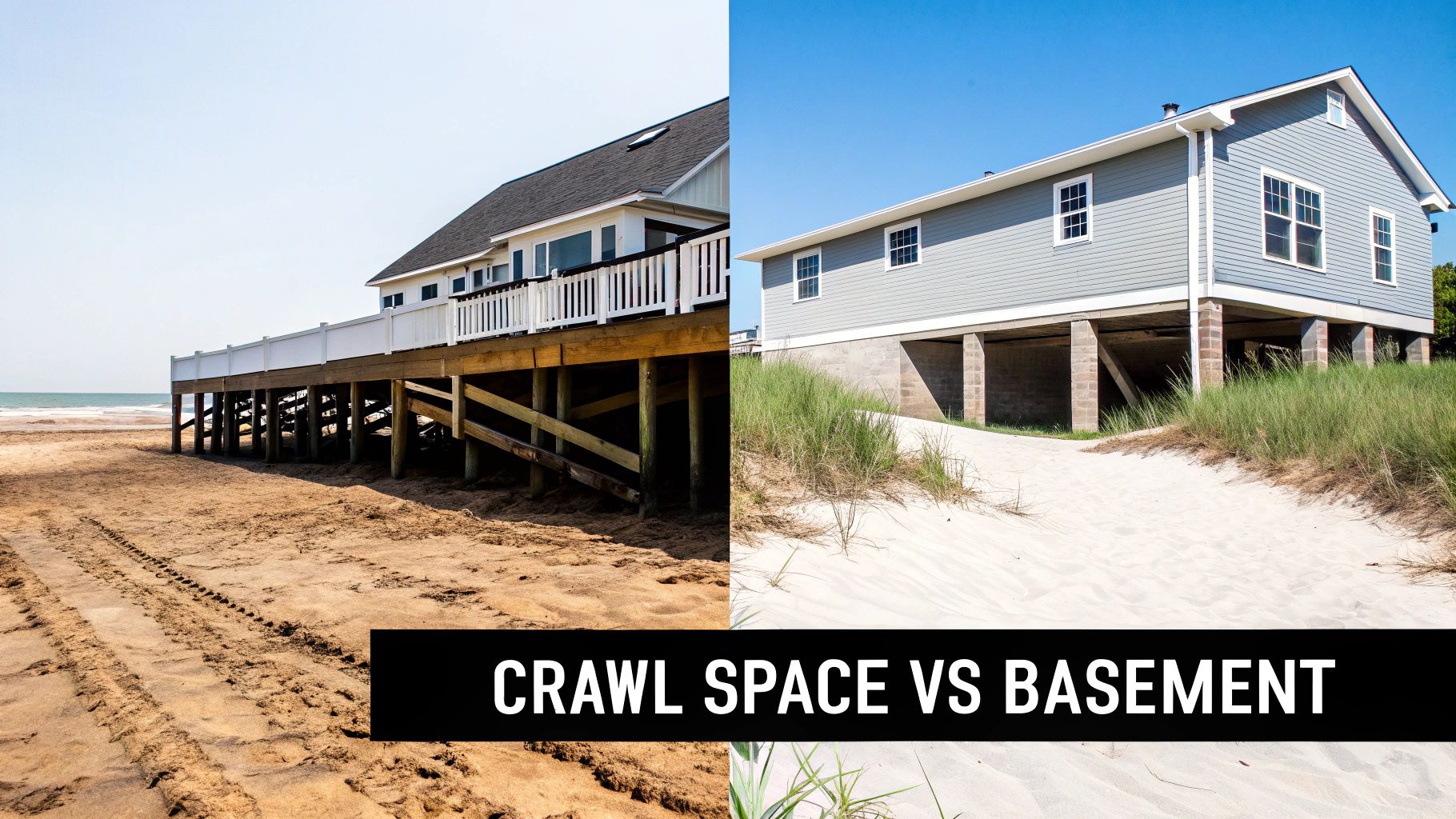
Thinking through these foundation options is a crucial part of the pre-construction phase, where smart planning saves a lot of headaches later. For anyone in Mount Pleasant or the surrounding areas, local realities like our sandy soil, strict flood zone rules, and historic district guidelines will absolutely shape this decision.
Key Factors for Charleston Homeowners
When you start comparing a crawl space to a basement, a few uniquely Charleston considerations should be at the top of your list.
- Flood Risk and Water Table: Our low elevation and notoriously high water table make any kind of below-ground construction a real challenge. Basements need an arsenal of waterproofing and drainage systems to keep water out, which is a constant battle in our part of the world.
- Initial Construction Cost: There's no getting around it—crawl spaces are significantly cheaper to build. They require far less excavation and concrete, making them the go-to, budget-conscious choice for most new homes and additions in the Lowcountry.
- Usable Square Footage: This is where a basement shines. It can nearly double your home's usable space, creating room for extra bedrooms, a home theater, or just plenty of storage. A crawl space, by contrast, is mostly just a home for your ductwork and pipes.
- Moisture and Humidity Control: Both foundations are susceptible to our oppressive humidity. Old-school vented crawl spaces can easily become damp breeding grounds for mold and pests. Basements, too, must be perfectly sealed and conditioned to avoid that classic damp, musty smell.
Crawl Space vs Basement a Quick Comparison for Charleston Homes
To get a quick handle on the major trade-offs, here’s a straightforward comparison focusing on what matters most for a property in our coastal climate.
| Factor | Crawl Space | Basement |
|---|---|---|
| Upfront Cost | Lower initial investment | Significantly higher initial investment |
| Flood Risk | Lower risk; elevates home | Higher risk; requires extensive waterproofing |
| Added Living Space | None | Adds significant usable square footage |
| Moisture Control | Requires encapsulation to manage humidity | Requires robust waterproofing & drainage |
| Common in Lowcountry | Very common, traditional choice | Rare due to cost and water table |
Ultimately, this table shows why crawl spaces are the default choice for our area. While a basement offers a tempting amount of extra space, the high cost and engineering hurdles associated with keeping it dry make it a rare sight in the Lowcountry.
Understanding the Structural Differences
When you get right down to it, the biggest difference between a crawl space and a basement is how they're built and how they become part of your home's structure. It isn't just a matter of height; it’s a fundamental engineering decision that’s tied directly to the ground beneath your feet, the local climate, and generations of building know-how. Pretty much every other comparison we'll make, from cost to upkeep, stems from these structural distinctions.
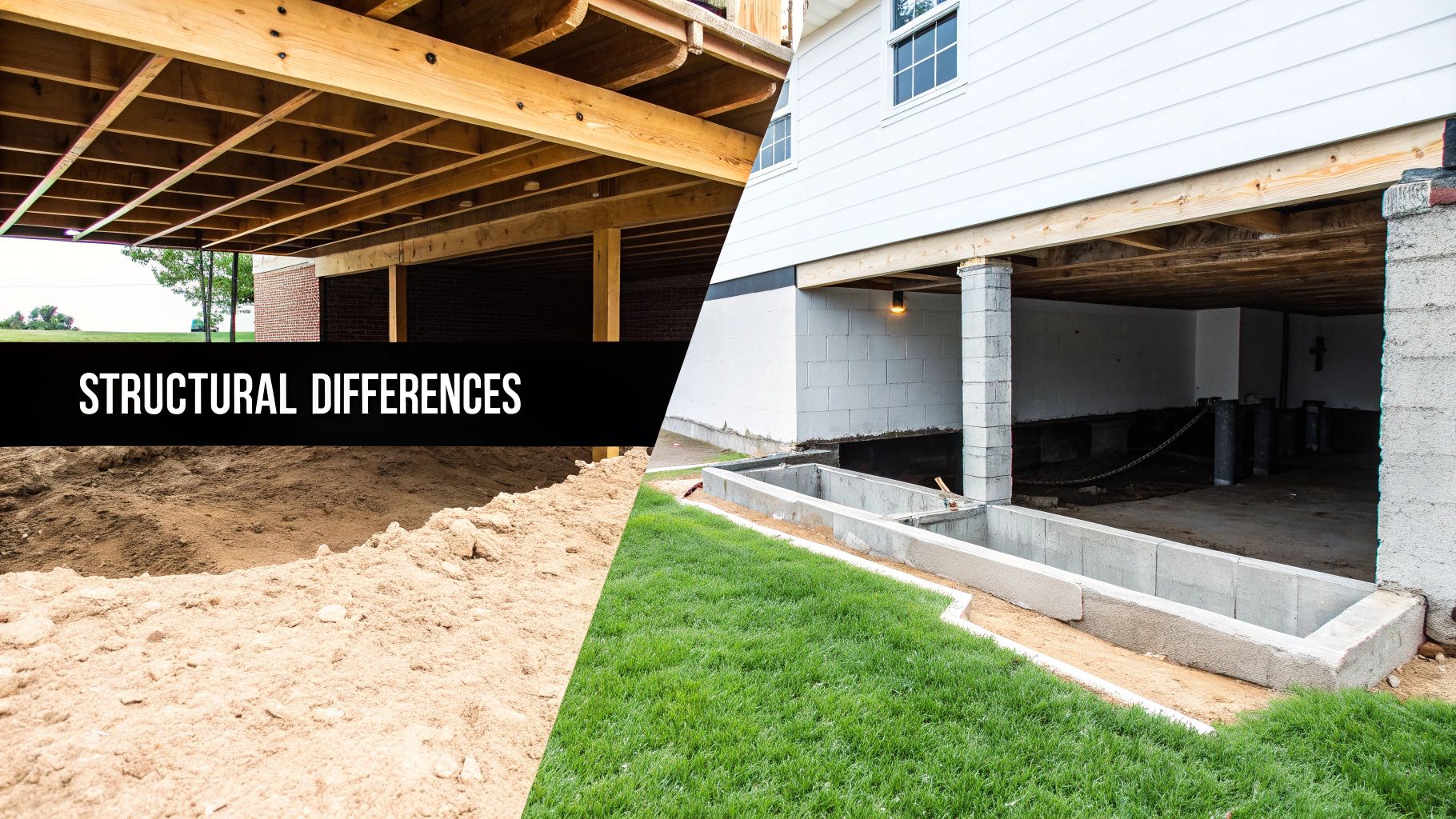
A crawl space is designed to lift your home’s main floor anywhere from 18 inches to four feet off the ground. It rests on simple, shallow footings with perimeter walls usually made from concrete blocks (CMUs) or sometimes poured concrete. This requires very little excavation, which is why it’s a faster and cheaper option, particularly in places with tricky soil like Charleston's sandy, high-water-table landscape.
A basement, on the other hand, is a full-height story that's mostly or entirely underground. This is a major construction project, involving digging down seven to ten feet. The walls have to be incredibly strong to hold back the immense pressure from the surrounding soil and water, so they’re built with poured concrete or advanced insulated concrete forms (ICFs). This deep, sturdy foundation is standard up north, where you have to get below the frost line to keep the house from shifting during freeze-thaw cycles.
Construction Methods and Materials
The way each foundation is built—and what it's built from—really defines its strengths and weaknesses. Think of a crawl space as a short wall that props up your floor joists, while a basement is a complete, underground level of the house.
- Crawl Space Construction: These often use concrete blocks, which can be porous. They need good exterior waterproofing to keep moisture from seeping through. The "floor" of the crawl space is often just dirt, sometimes covered with a basic plastic vapor barrier.
- Basement Construction: Basements rely on solid, monolithic poured concrete walls to provide strength and keep water out. Newer basements might use high-tech materials like ICFs, which sandwich a thick layer of insulation between concrete, giving you fantastic energy efficiency and moisture control right out of the box.
For anyone in the Lowcountry, this is the crucial point: a crawl space is designed to lift your home away from ground moisture. A basement is engineered to actively resist being surrounded by it. Both have their uses, but our coastal environment makes the first approach a much more straightforward solution.
Regional Building Practices and Why They Matter
Walk through different parts of the country, and you'll see that foundation types are no accident. They are a direct response to the local climate and geology. The national data paints a clear picture: basements are the norm in the North, while slabs and crawl spaces are king in the South.
In 2021, a whopping 78.7% of new homes in New England were built with basements. But head south, and that number plummets. In the East South Central region, for example, 42.2% of new homes were built on crawl spaces. This isn't just people sticking to old habits; it’s about what makes practical sense. You can check out more details on these single-family foundation trends.
Here in Charleston, trying to dig a deep basement means fighting a high water table and considering seismic activity—it quickly becomes a complex and expensive engineering challenge. A properly built and encapsulated crawl space, however, gives us the elevation and stability we need for our coastal environment without starting a constant war with groundwater.
A Financial Analysis of Construction and Long-Term Value
When you’re weighing a crawl space against a basement, your budget is often the deciding factor. But the true cost isn't just the number on the builder's initial quote. To get the full picture, you have to look at the upfront construction costs, the money you'll spend on upkeep over the years, and what it all means for your home's value when it's time to sell.
The most obvious difference is the initial price tag. Crawl spaces are, without a doubt, the more wallet-friendly choice to start. They require less excavation and fewer materials, which is why they’ve become the go-to for so many new homes and additions here in the Lowcountry.
A basement, on the other hand, requires a much bigger investment from day one. But what you get in return is the potential for a whole new level of high-quality living space, fundamentally changing your home's value proposition.
Upfront Construction Costs
The cost gap between these two foundations is pretty stark. Nationally, building a new crawl space foundation typically lands around $14,000, which breaks down to about $5 to $16 per square foot. That reflects the relatively shallow digging involved.
Basements are a different story. You're digging down 7 to 10 feet to get full headroom, which pushes the average construction cost closer to $30,000. On a per-square-foot basis, you’re looking at $25 to $50, and that’s before you even think about finishing the space. A fully finished basement can easily top $50,000.
Here in Charleston, those basement costs can climb even higher. Our high water table means you need specialized engineering and waterproofing, making the initial financial appeal of a crawl space that much stronger for many local homeowners.
Long-Term Expenses and Maintenance
The savings on day one are only part of the equation. What you'll spend over the life of your home on maintenance and repairs is just as important.
- Crawl Space Maintenance: Let’s be frank: a classic vented crawl space in our humid climate is a recipe for trouble. To head off moisture, mold, and pest problems, encapsulation is a must-have investment, usually running several thousand dollars. That system also needs a dehumidifier, adding to your monthly power bill, plus you'll want to inspect the vapor barrier periodically.
- Basement Maintenance: A well-designed basement relies on a sump pump system, which needs regular testing and will eventually need to be replaced. Professional waterproofing is a serious upfront cost, but it’s your primary defense against catastrophic water damage. It’s also wise to get the drainage systems inspected annually to make sure they're clear and working properly.
The core financial trade-off is this: with a crawl space, you save money upfront but should plan on investing in encapsulation to keep your home healthy. With a basement, you invest heavily in robust waterproofing from the start to protect a much larger, more valuable part of your home.
Return on Investment and Resale Value
This is where the financial paths of crawl spaces and basements really diverge. A crawl space, when it's properly sealed and maintained, does its job by protecting your home’s structural integrity and value. It works quietly behind the scenes but doesn't add any marketable living area.
A finished basement, however, directly and significantly boosts your home's value. When you transform that space into a den, bedroom, or apartment, you’re adding heated and cooled square footage that appraisers love. It's not uncommon to see a 70% or higher return on investment.
For anyone focused on maximizing both their living space and long-term equity, a basement is a powerful financial tool. As you plan, it's useful to understand the value difference between a finished versus an unfinished basement to map out your project. For more on financial planning, take a look at our guide on how to budget for your home renovation.
Managing Lowcountry Risks from Moisture and Storms
Living in the Lowcountry means embracing a stunning environment, but it also means dealing with its less-charming side: relentless humidity and the very real threat of major storms. When you’re weighing a crawl space against a basement, you're doing more than just picking a foundation. You’re choosing your home’s primary defense against water damage, pests, and the aftermath of a hurricane. Each has its own weak spots that demand different strategies to keep your home safe and sound.
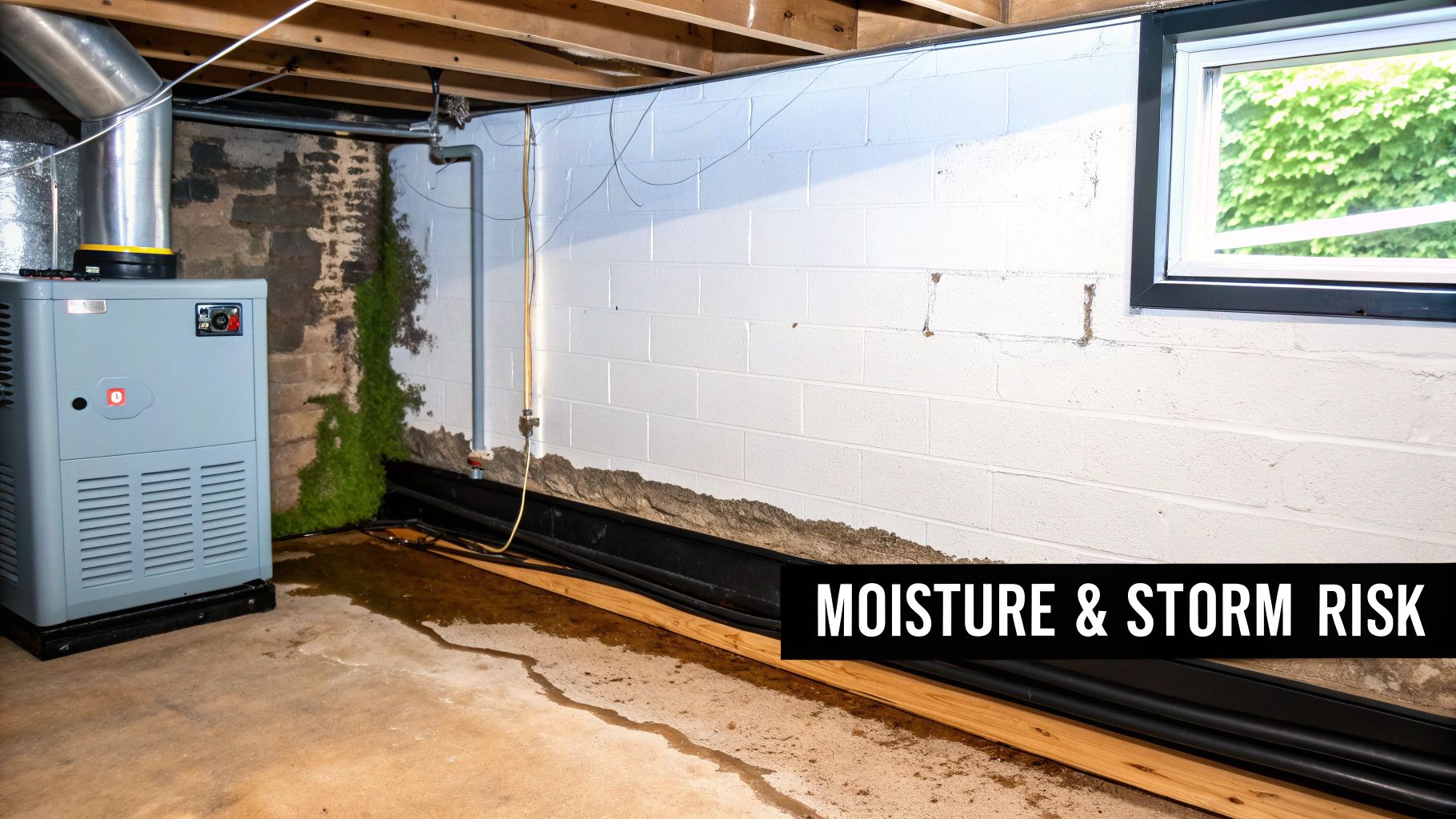
The classic vented crawl space, a common sight in older Charleston homes, is practically an open invitation for moisture. Those open vents pull in our humid air, which then condenses all over cool ductwork and floor joists. It’s a recipe for wood rot, musty mold, and unhealthy air circulating through your home.
Basements, on the other hand, fight a different water battle. Being underground puts them in a constant struggle against hydrostatic pressure—that’s the force of groundwater pushing relentlessly against the foundation. If the waterproofing isn't perfect, that pressure will find a way to shove water through the tiniest crack, leading to anything from a slow leak to a full-blown flood.
The Battle Against Humidity and Mold
For a crawl space in our climate, moisture control isn't just a good idea; it's absolutely critical for your home’s long-term health. Tossing down a simple plastic sheet on the dirt floor just won't cut it here.
The gold standard for a crawl space in Charleston is full encapsulation. This means sealing up the vents for good, wrapping the ground and walls in a thick, durable vapor barrier, and running a dehumidifier. The result is a clean, dry, conditioned space that protects your home’s wooden bones from decay and mold.
While basements aren't as exposed to the humid air, they can still become moisture traps. Once a leak starts, that water has nowhere to go, quickly leading to that classic musty basement smell and dangerous mold growth. A multi-layered defense system is non-negotiable for a dry, healthy basement.
- Exterior Waterproofing: This is your first line of defense, a waterproof membrane applied to the outside of the foundation walls to block water before it even touches the concrete.
- Interior Drainage: An interior drain tile system acts as a backup, catching any water that does get through and channeling it to a sump pump.
- Sump Pump with Backup: A high-quality sump pump is the heart of the system, actively pumping water out and away from your home. A battery backup is a must, ensuring it works during the power outages that inevitably come with big storms.
Knowing the right crawl space repair solutions helps you tackle issues like moisture and rot before they become major structural problems.
Resilience During Storms and Flooding
When the storm clouds gather, the conversation shifts to elevation. Charleston's position within various FEMA flood zones is a huge factor in foundation design and what’s allowed by code.
Here, an elevated foundation—like a well-built crawl space—often has a clear advantage. By lifting the main floor of your house above the Base Flood Elevation (BFE), you dramatically lower the odds of floodwaters ever getting inside. This is a primary reason why crawl spaces are still the go-to choice for new construction along the coast.
A basement, by its very nature, is more vulnerable to flooding from storm surge or torrential rain. That said, a modern basement, engineered with our climate in mind, can be incredibly flood-resistant. This requires heavy-duty waterproofing, redundant sump pumps, and smart landscaping to slope water away from the foundation.
Ultimately, your choice boils down to your property’s specific location and your comfort level with risk. An elevated crawl space offers passive protection—it’s safe because it’s high. A basement requires an active, well-maintained system to provide that same peace of mind. To keep your property ready for whatever the seasons bring, be sure to follow these essential seasonal maintenance tips designed for Lowcountry homes.
How You Can (or Can't) Use the Space
When you get past the technical and financial details, the real question becomes about your lifestyle. This is the part where you stop thinking about your house as just a structure and start seeing it as a home. What you choose—a crawl space or a basement—draws a clear line around your living area and shapes what your home can be down the road.
A crawl space is, at its heart, a utility zone. It’s there to create a buffer from the damp ground and give plumbers and electricians a place to run pipes, wires, and ductwork. It's a necessary feature, but it offers nothing in the way of day-to-day living. At best, it's a cramped service area; it will never be your kid's playroom or a quiet home office.
A basement, on the other hand, is pure potential. It’s a blank canvas. An unfinished basement immediately provides fantastic storage, freeing up your garage and closets from seasonal decorations and bulky equipment. But its true power is realized when you decide to finish it, turning that raw space into a genuine extension of your home.
The Crawl Space: A Utility Player, Not a Living Space
Even the cleanest, most well-maintained crawl space has a very limited job description. Its purpose is purely mechanical, and most homeowners only venture in when a professional needs access or something goes wrong.
- Tough for Storage: Sure, you can stash things in an encapsulated crawl space, but it’s far from ideal. The low headroom, awkward access, and lingering moisture risk make it a poor choice for anything you value or need to get to often.
- Zero Living Potential: Building codes are crystal clear on this: you can't convert a crawl space into a habitable room. The ceiling is too low, and it simply wasn't engineered for people to occupy.
- Value Comes from Health, Not Square Footage: The only real "upgrade" for a crawl space is encapsulation. This is a great investment that improves your home’s air quality and lowers energy bills, but it adds zero usable square footage.
The Basement: Unlocking Your Home's Future
A basement is where your home’s ability to grow and adapt truly lives. Finishing a basement is one of the most cost-effective ways to add a huge amount of high-value living space without the headache and expense of building a new addition.
This isn't just an idea; construction data backs it up. Homes built with basements have historically been much larger than those with crawl spaces because they're designed from the start to provide more living area. For instance, in the East South Central region, homes with basements averaged 2,197 square feet, while crawl space homes came in at just 1,610 square feet. With the right design-build team, a basement can become a prime living space, adding an average of 1,112 square feet nationally and seriously boosting your property value. You can dig into more of these foundation and home size trends yourself.
A basement fundamentally changes the math of your home. It’s not just storage; it’s an investment in your lifestyle, offering a dedicated space for family, hobbies, and relaxation that a crawl space simply cannot provide.
Just think about what’s possible: a home theater for family movie nights, a dedicated home office for focused work, a private guest suite, or a sprawling playroom where the kids can run wild. Each of those adds a new dimension of comfort and function to your everyday life.
When you lay it all out, the comparison is pretty stark. A crawl space is a practical but passive part of your home’s foundation. A basement is an active, dynamic space with nearly endless potential for remodeling, making it an incredible asset for anyone looking to maximize their home’s long-term value and enjoyment.
Making the Right Choice for Your Charleston Property
When it comes to the crawl space vs. basement debate, there’s no single "best" answer. The real goal is finding the right foundation for your specific situation here in the Lowcountry. After weighing the structural differences, costs, and practical day-to-day realities, your choice should come down to a clear-eyed assessment of your budget, lifestyle, and your property's unique challenges.
This visual guide breaks down the core decision you're facing: Are you prioritizing more usable living space, or are you focused on keeping upfront construction costs in check?
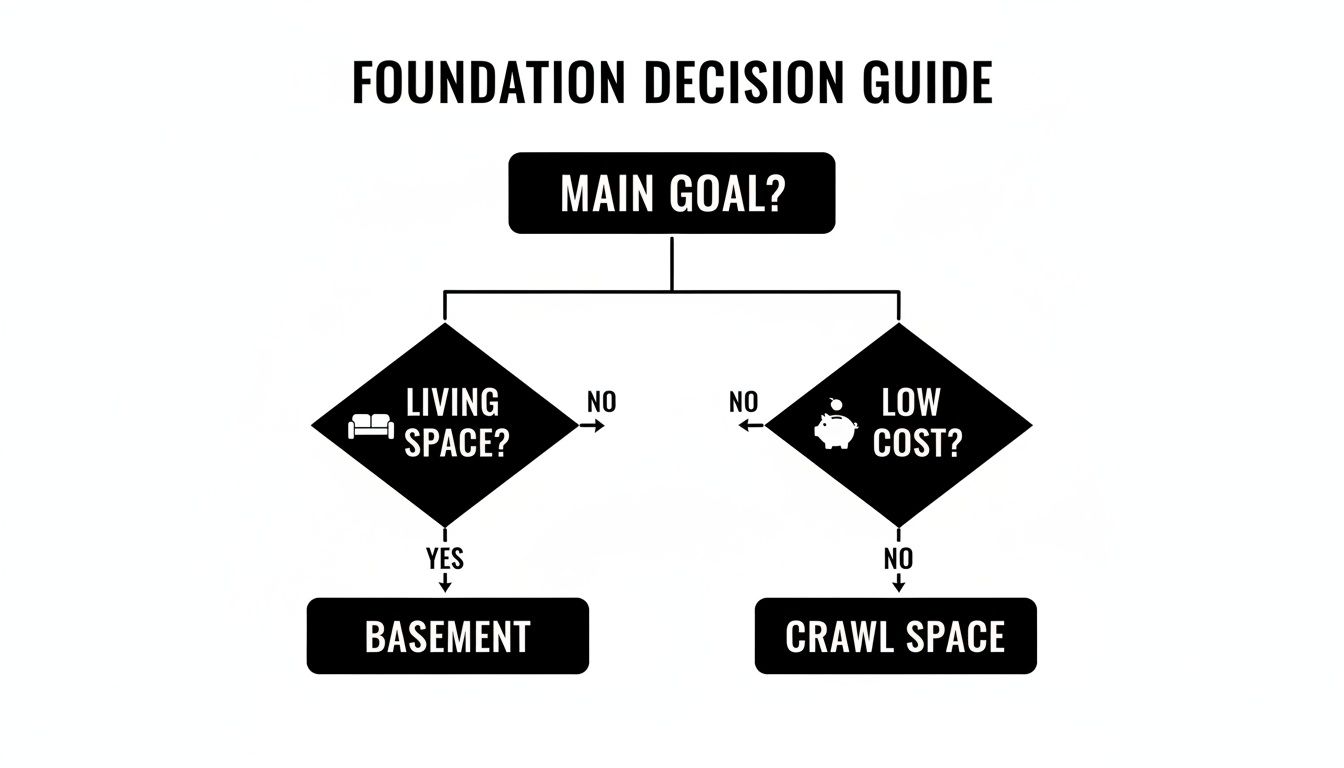
As you can see, the path is pretty clear. If getting the most habitable square footage is your number one goal, a basement is the way to go. If minimizing initial spending is the priority, a crawl space is the immediate and practical choice.
Your Decision Checklist
To really nail this down for your Charleston property, run through these questions. Your answers will build a personal framework that points you directly to the foundation that makes the most sense for your new build or major renovation.
- What's my main priority? Is it about maximizing living space for your family, or is it about keeping the initial build costs as low as possible? Be honest with yourself—this is the biggest fork in the road.
- Is my property in a FEMA flood zone? If the answer is yes, an elevated foundation like a crawl space isn't just a good idea; it might be required by local building codes to protect your home from storm surge.
- What's my long-term vision for this house? Think 10-15 years down the line. Could you see yourself needing a guest suite, a home gym, or a dedicated playroom? A basement gives you that built-in flexibility for the future, while a crawl space is purely structural.
- How much maintenance am I willing to take on? A modern, dry basement is fantastic, but it depends on diligent upkeep of sump pumps and drainage systems. An encapsulated crawl space, on the other hand, is pretty low-maintenance once it's set up, but it offers no lifestyle perks in return.
Situational Recommendations for Lowcountry Homeowners
Let's ground this in some common Charleston scenarios. Chances are, your project fits into one of these buckets, which should make the crawl space vs. basement choice much clearer.
If your top priorities are maximizing your home's long-term resale value and functional living area—and you have the budget for serious engineering and waterproofing—a basement is a powerful investment. It fundamentally changes what your property can be.
But let's be realistic. If you're building on a lot with a high water table or in a strict flood zone, an elevated crawl space is almost always the most practical and resilient option. There's a reason it's the default choice in our coastal region: it provides reliable protection from moisture and flooding at a fraction of a basement's cost.
For historic renovations downtown, a crawl space is nearly always the only path forward. The need to preserve the original structure, combined with navigating a maze of regulations, makes excavating a new basement next to impossible. Here, the focus is on restoration and protection, making a well-encapsulated crawl space the perfect solution.
Ultimately, the right choice is a balance between your personal goals and the practical realities of building in our beautiful—but demanding—coastal environment. By thinking through these factors, you can be confident that your home's foundation will be a source of stability, safety, and value for decades to come.
Common Questions from Charleston Homeowners
When you're weighing a crawl space against a basement, a lot of the same questions come up, especially here in the Lowcountry. Let's get you some straightforward answers.
Can You Even Build a Basement in a Flood Zone Like Charleston?
Technically, yes, but it’s a serious project that requires rock-solid engineering and waterproofing. Given our high water table, a modern basement here has to fight back against intense hydrostatic pressure—the force of groundwater pushing against your foundation.
It’s not as simple as just digging a hole. You need a comprehensive system to keep it dry:
- Exterior Waterproofing: A heavy-duty membrane wrapped around the outside to stop water before it even touches the concrete.
- Interior Drainage: A channel system inside to catch any rogue water that might find a way in.
- Sump Pump with Battery Backup: This is your last line of defense, actively pumping water out. The battery backup is non-negotiable for our storm seasons when the power goes out.
It's doable, but you absolutely need an expert who knows Charleston's soil and FEMA flood maps inside and out. For most homes right on the coast, an elevated foundation is still the smarter, safer bet.
Is It Really Worth the Money to Encapsulate My Crawl Space?
One hundred percent, yes. In a climate as humid as ours, a classic vented crawl space is basically a welcome mat for moisture, mold, and termites. Those aren't just annoyances; they can eat away at your home's structure and tank your indoor air quality.
Think of encapsulation less as an upgrade and more as essential home maintenance in the Lowcountry. You’re sealing off the vents, laying down a tough vapor barrier, and adding a dehumidifier to create a space that’s clean, dry, and controlled.
It’s a one-time cost that pays you back by protecting your foundation from rot, making your whole house more energy-efficient, and finally getting rid of that musty smell that creeps upstairs. It's one of the best things you can do for a home with a crawl space in this area.
Which Foundation Is Better for My Energy Bills?
A well-finished and properly insulated basement usually wins this one. The earth packed around it provides natural insulation, keeping the temperature much more stable all year long. This takes a huge load off your HVAC system.
On the other hand, a standard, unsealed crawl space is an energy hog. It's full of leaks and moisture that make your heating and air conditioning work overtime.
But—and this is a big but—a fully encapsulated and conditioned crawl space closes that gap significantly. By creating a sealed and insulated buffer, it can perform almost as well as a basement. For either foundation type, the real keys to efficiency are professional-grade insulation and air sealing.
Choosing the right foundation is one of the biggest decisions you'll make for your home. At Citadel Enterprises, we've spent decades helping Charleston homeowners make the right call, blending deep local expertise with high-quality construction. Contact us today to start the conversation.