
When you’re thinking about adding a half bath, one of the first questions that comes to mind is, “What’s this going to cost me?” The answer really boils down to one key decision: are you working within your home’s current footprint, or are you building a brand-new addition?
Nationally, you can expect a project that converts a closet or part of a hallway to run somewhere between $5,000 to $7,500. If you’re building out, that price tag for a small addition can easily jump to $10,000 to $15,000, or even more. These numbers are a great starting point for wrapping your head around a realistic budget.
Your Quick Guide to Half Bath Addition Costs
A half bath, or what many of us call a powder room, is one of the smartest upgrades you can make to your home. It’s a simple space—just a toilet and a sink—but it punches well above its weight in adding convenience and boosting your home’s value. The straightforward nature of a half bath is exactly what makes it such a popular and budget-friendly project.
The biggest factor influencing the final cost is where you decide to put it.
Converting Space vs. Building an Addition
The best way to think about it is this: converting existing space is like remodeling a room you already have, while building an addition is like adding a new wing to your house.
Finding a spot inside your home—like an oversized closet, that awkward nook under the stairs, or a corner of the laundry room—is almost always the more affordable route. You’re using the structure that’s already there, which saves a ton on foundational and framing work.
On the other hand, building an addition is a much bigger undertaking. It means pouring a new foundation, framing walls, adding a roof, and finishing the exterior. All that extra labor and material is why the price climbs so quickly.
Looking at recent industry data, the difference becomes crystal clear. A conversion project often falls in the $200 to $300 per square foot range. But for a new addition, you’re looking at $400 to $600 per square foot because of all the heavy lifting involved. You can find more detailed cost breakdowns on resources like HomeGuide.com.
The most significant financial decision you’ll make is whether to work within your home’s existing walls or to expand its footprint. This choice alone can double the project’s total cost before a single fixture is chosen.
To give you a clearer picture, let’s break down what you can expect to see in terms of cost, both across the country and right here in the Charleston area.
Half Bath Project Cost At-a-Glance
This table lays out the typical investment for both types of projects. Keep in mind that Lowcountry costs can be slightly higher due to local labor rates and the unique demands of building in our coastal region.
| Project Type | National Average Cost Range | Charleston/Lowcountry Estimated Cost Range |
|---|---|---|
| Existing Space Conversion | $5,000 – $7,500 | $6,000 – $9,000+ |
| New Home Addition | $10,000 – $15,000 | $12,000 – $20,000+ |
As you can see, the path you choose has a major impact on the budget. While a new addition offers more flexibility in design and placement, a conversion delivers incredible value by making smart use of the space you already own.
Breaking Down Your Half Bath Budget
To really get a handle on the cost of adding a half bath, you have to look past the final number on a quote. It’s like looking at a grocery receipt—the total only makes sense when you see what each item costs. A half bath budget is really just a collection of smaller, individual expenses that add up.
When you break it down this way, you can see exactly where your money is going. From the unseen plumbing work behind the walls to the final coat of paint, every piece plays a part in the overall cost. This kind of detailed view is crucial for making smart choices, comparing contractor estimates, and finding places where you might be able to save a little.
The Major Cost Categories
Let’s get one thing straight: the biggest chunk of any renovation budget is almost always labor. Adding a half bath is no different. You can expect labor to eat up 40% to 60% of the total project cost. This pays for the time and skill of the professionals making it happen—the carpenters, plumbers, electricians, and painters.
After labor, the rest of your budget gets split among a few key categories. The costs here will swing based on how complex your project is and the quality of the materials you pick out.
Here’s a look at where the money typically goes:
- Plumbing (15-25%): This is the heart of your new bathroom. This slice of the budget covers running new hot and cold water lines, installing drain and vent pipes, and—most importantly—tying everything into your home’s main plumbing stack.
- Fixtures (10-20%): These are the things you’ll actually see and use every day: the toilet and the vanity or sink. The price range here is huge. A basic, no-frills toilet might run you $200, while a high-end designer model can easily top $1,000.
- Framing and Drywall (5-10%): This is the skeleton of the new room. It involves building the walls that create the space and then covering them with drywall, which gets taped and mudded to create that smooth surface ready for paint.
- Electrical Work (5-10%): Every bathroom needs good lighting, an exhaust fan (a code requirement in most places), and at least one GFCI outlet for safety. This line item covers running the wires and installing all the necessary fixtures.
This chart gives you a great visual for how these costs compare, especially when deciding between converting an existing space versus building a brand-new addition.
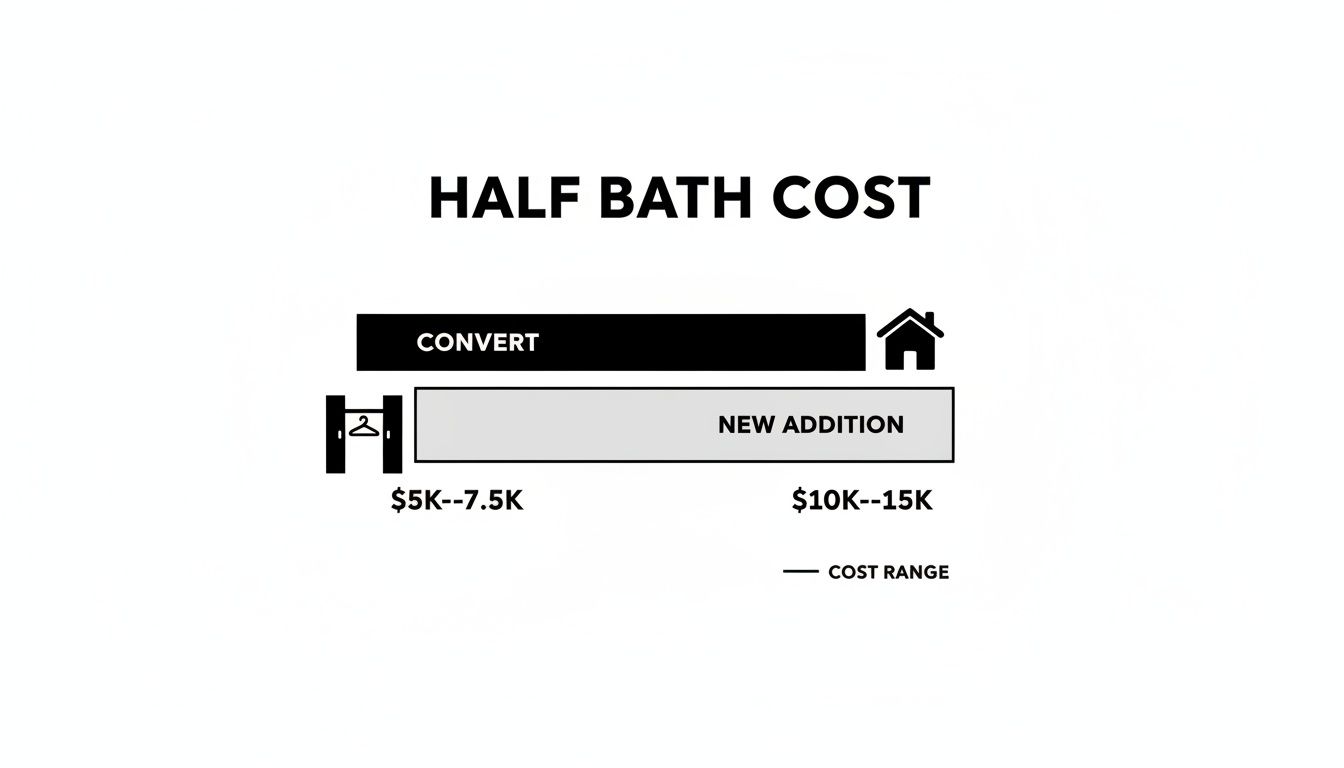
As you can see, working within your home’s existing footprint is almost always the more budget-friendly route.
Diving Deeper: A Typical Cost Breakdown
To make this even clearer, let’s look at how a typical half bath budget might be divided by percentage. This helps you see how each piece of the puzzle contributes to the whole.
| Expense Category | Percentage of Total Budget | Key Considerations |
|---|---|---|
| Labor | 40% – 60% | The most significant cost; covers all skilled trades. |
| Plumbing | 15% – 25% | Varies based on distance to existing plumbing lines. |
| Fixtures | 10% – 20% | Toilet and vanity selection are the main drivers here. |
| Electrical | 5% – 10% | Includes lighting, exhaust fan, and GFCI outlets. |
| Framing/Drywall | 5% – 10% | The cost to build and finish the room’s structure. |
| Finishes & Other | 5% – 15% | Flooring, paint, trim, accessories, and permits. |
This table is a great guide, but remember that every project is unique. Your specific percentages will shift based on your home’s layout and your design choices.
Finishes and Final Touches
While the big systems are the backbone of the project, the finishes are what give your new half bath its personality. These costs can vary wildly because they’re based entirely on your personal style.
Finishing touches include things like:
- Flooring: You could go with affordable and tough luxury vinyl tile (LVT), or opt for classic ceramic or porcelain tile, which can get pricey, especially with more complex patterns.
- Paint and Trim: A fresh coat of paint, new baseboards, and door casings give the room a clean, polished look.
- Lighting and Accessories: This covers everything from the vanity light and mirror to the faucet, toilet paper holder, and towel hooks.
Finally, don’t forget about the less exciting—but absolutely essential—costs.
Permits: This is an easy one to overlook. Any project that involves new plumbing or electrical work requires a building permit. Here in the Charleston area, you can expect permits to cost anywhere from $200 to $800, depending on your local municipality.
Working with an experienced contractor from the start means these costs get baked into your initial budget, so there are no nasty surprises later on. For an even more granular look at how these elements are priced, a good bathroom remodel cost breakdown can provide more insight.
By understanding how all these pieces fit together, you’re in the driver’s seat. You can talk with your contractor about where you want to splurge on high-end materials and where standard, quality options will do just fine. For more great advice, take a look at our guide on how to budget for a home renovation and start planning your project with confidence.
What Can Drive Up the Cost of Your Project?
An initial estimate is a great starting point, but it’s the surprises—the things you can’t see behind the walls—that really shape the final price tag. These aren’t about contractors hiding fees; they’re the unique quirks and challenges of your specific home that only reveal themselves once the work begins.
Think of it like planning a road trip. You budget for gas and hotels, but you can’t predict a flat tire or a surprise detour. In remodeling, those detours pop up as tricky plumbing routes, structural oddities, and the special demands of working on older homes. Knowing what these potential hurdles are ahead of time is the best way to build a realistic budget and avoid stress down the line.
The Challenge of Distant Plumbing
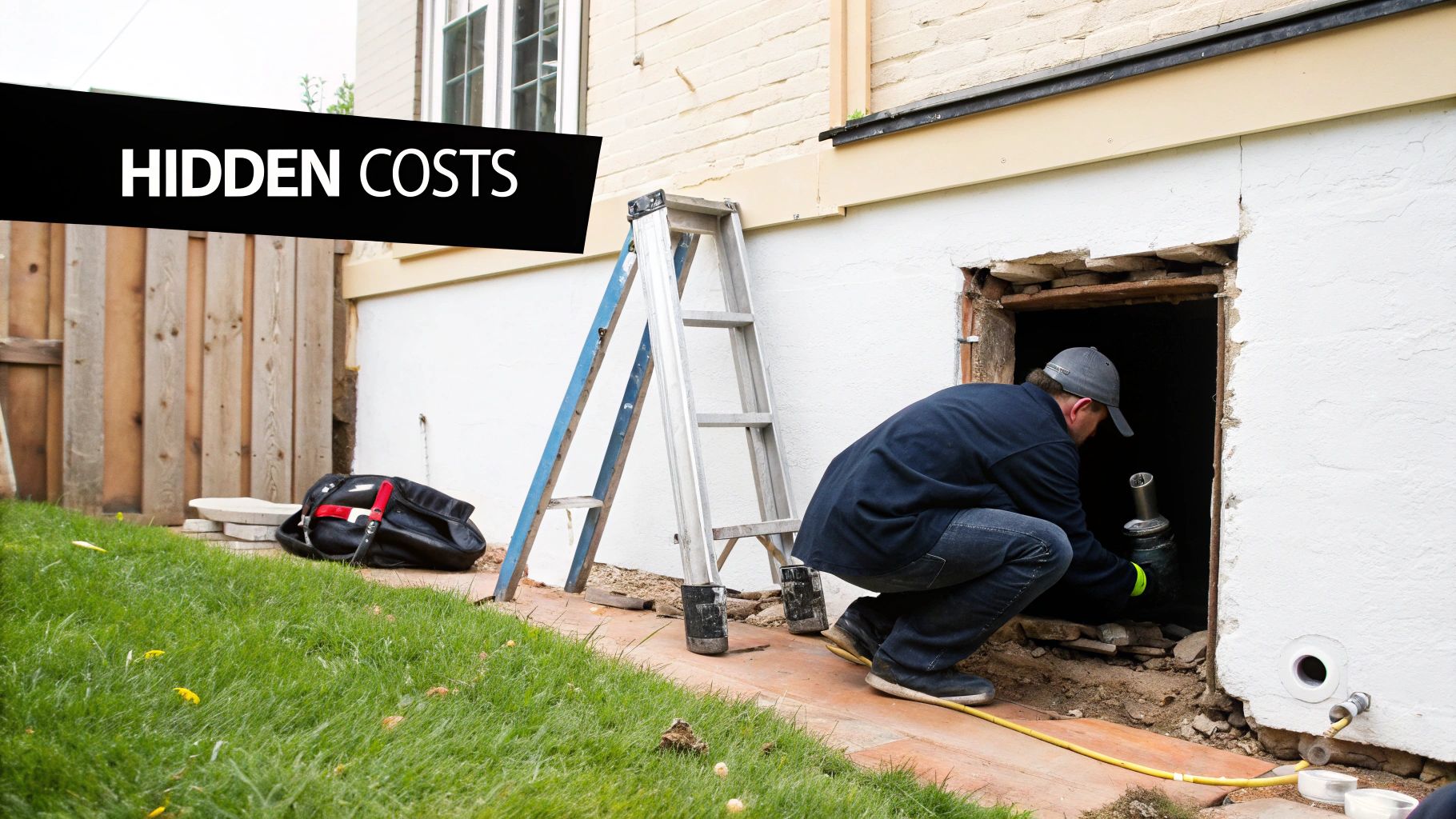
Where you want to put your new half bath in relation to your existing plumbing is probably the biggest single factor affecting your cost. Every house has a main drain and vent pipe called a sewer stack. The dream scenario is tying into this stack easily.
But what if your ideal spot is on the other side of the house? Suddenly, the project gets a lot more complicated. It’s like trying to get on the highway from a side street a mile away—you have to build a much longer, more complex on-ramp. This means running new drain lines that have to maintain a precise downward slope to work correctly.
This can snowball into several expensive problems:
- Cutting Through Joists: Plumbers might have to cut through your floor joists, which often means we need to bring in a structural engineer to make sure your home’s integrity isn’t compromised.
- Opening Up Ceilings: To get to the pipes, we may need to tear out the drywall on the ceiling of the room below, which adds significant repair and refinishing costs.
- Adding Pumps: If you’re putting the bathroom in a basement, a special sewage ejector pump might be necessary to get waste up to the main drain line, adding another piece of equipment and complexity to the job.
Especially in older homes, you never quite know what you’ll find. Sometimes it makes sense to look at upgrading your home’s plumbing system while you’re already at it.
Historic Home Constraints in Charleston
Working on a historic home, especially anywhere near downtown Charleston, is a whole different world. You aren’t just adding a bathroom; you’re carefully weaving a modern feature into the historic fabric of a home while following a mountain of local rules.
In Charleston’s historic districts, adding a half bath can easily cost 15% more than a typical project. This comes from specialized permits, the hunt for restoration-grade fixtures, and the delicate, meticulous labor required.
Navigating these projects means:
- Getting Approval: Any changes to the exterior, and often major interior work, have to go before architectural review boards or preservation societies.
- Sourcing the Right Materials: Finding trim, flooring, or fixtures that look right and meet strict guidelines costs more and takes longer.
- Dealing with Old Bones: Homes built a century ago have plaster walls, quirky framing, and old wiring. Bringing these up to code safely requires a specialized, careful approach.
Unexpected costs like structural engineering ($500-$2,500) or HVAC rerouting ($1,000-$3,500) are also more common in these complex historic renovations.
Access and Environmental Factors
Finally, simple logistics can add to your bill. If your home is tough to get to—think no driveway or tight street parking—it takes our team more time and effort just to get materials and equipment on-site.
Living in the Lowcountry also brings its own set of environmental challenges. If your home is in a coastal flood zone, any new construction has to meet strict FEMA regulations. This could mean elevating the new addition, using special flood-resistant materials, or installing foundation vents, all of which impact the bottom line.
A good local contractor will spot these potential issues early on. For a closer look at these variables, check out our post on what impacts the cost of a bathroom remodel.
Calculating the Return on Your Investment
Adding a half bath is more than just a home improvement project; it’s a smart play for your property’s future. When you’re looking at the cost to add a half bath, it’s easy to get stuck on the initial price tag. But to get the full picture, you have to look at what it gives back—both in real dollars and in daily convenience.
Think of it this way: adding a sought-after feature to a car right before you sell it. That upgrade doesn’t just make it more appealing to buyers; it can directly bump up the asking price. A powder room does exactly the same thing for your home. This is especially true in a competitive market like Charleston, where buyers expect modern comforts in both new builds and historic homes.
Boosting Your Home’s Market Value
From a financial perspective, a half bath is one of the smartest upgrades you can make. It solves a classic problem for families and guests alike: the dreaded bathroom line. That extra bit of function is something potential buyers are absolutely willing to pay more for, and you’ll see that reflected in the project’s Return on Investment (ROI).
The numbers back it up. Adding a half bath consistently delivers a solid ROI, with homeowners often getting back a good chunk of what they put in. Some data shows you could recoup anywhere from 30% to 70% of the cost at resale.
To get specific, Remodeling Magazine’s well-respected Cost vs. Value report shows that a midrange half bath addition costing around $58,586 can get back 34.7% of its cost. That’s an immediate boost of over $20,000 to your home’s value. Considering that 65% of recent home sales involved bathroom upgrades, it’s clear how much this matters to buyers. If you want to dive deeper into the numbers, you can review data-driven cost analyses that break it all down.
The Intangible ‘Livability’ Return
But let’s be honest, the financial stats don’t tell the whole story. The real payoff from a new half bath often comes from how it changes the rhythm of your daily life. We call this the “livability” return—the kind of convenience you just can’t put a price tag on.
A well-placed powder room completely transforms how your home works. It’s not just another toilet; it’s the solution that ends morning chaos, gives guests their own space, and makes having people over feel seamless.
Think about these everyday scenarios:
- Guest Convenience: No more sending visitors upstairs into your private family areas. A first-floor powder room keeps things comfortable and separate.
- Reduced Morning Congestion: It’s a game-changer for the morning rush hour, giving everyone another option to get ready and out the door on time.
- Increased Accessibility: For older relatives or anyone with mobility challenges, having a bathroom on the main floor can be a necessity.
This boost in livability is really an investment in your family’s comfort. While the dollar-for-dollar ROI is a great motivator, it’s the daily ease and functionality that homeowners are still raving about long after the dust has settled. It simply makes your house a better place to live.
When you pair that powerful financial return with the daily quality-of-life upgrade, adding a half bath becomes a clear win for both your lifestyle and your wallet.
What to Expect During Your Renovation
Going from an empty space to a finished powder room is an exciting journey, and knowing what’s coming next makes the whole thing feel less daunting. While every home has its own quirks, a professionally managed renovation follows a clear, logical sequence.
On average, you can expect the actual construction of a new half bath to take anywhere from four to eight weeks. Keep in mind, this is just for the hands-on work. The timeline can stretch a bit depending on things like how long it takes for custom-ordered tile to arrive, the complexity of the plumbing, or navigating the local permitting process.
The Three Core Phases of Your Project
We like to think of a renovation in three distinct acts. Each stage has its own focus, and one flows right into the next, all managed by your design-build team to keep things running smoothly.
-
Phase 1: Design and Planning (1-3 weeks): This is where we turn your ideas into a concrete plan. It all starts with a consultation to nail down your goals and budget. From there, we dive into design, drafting layouts and helping you choose everything from the vanity and faucet to the perfect tile. Once the design is locked in and materials are on order, we take care of the paperwork. The local permitting process for home remodels is a crucial step to ensure every part of the job is safe and up to code.
-
Phase 2: Construction and Rough-Ins (2-4 weeks): Now the real transformation begins. This phase is all about building the bones of the new bathroom and getting the essential systems in place.
-
Phase 3: Finishing and Final Walkthrough (1-2 weeks): This is the home stretch! All the beautiful details you selected finally come together, turning a construction zone into a polished, usable room.
What Happens During Construction
The construction phase is where you’ll see the most day-to-day activity. It starts with getting the space ready and laying the groundwork for everything that makes a bathroom work.
- Demolition and Framing: First, we’ll carefully demo any existing structures in the way. Then, we frame out the new walls that will define the footprint of your half bath.
- Plumbing and Electrical Rough-Ins: This is the critical behind-the-scenes work. Our licensed plumbers run the new water supply and drain lines, and our electricians install the wiring for lights, switches, outlets, and the exhaust fan. All of this has to be inspected by the city before we can close up the walls.
- Drywall and Insulation: Once we get the green light from the inspectors, we insulate the walls (great for soundproofing) and hang the drywall. The drywall is then meticulously taped, mudded, and sanded to create a seamless, smooth surface ready for paint.
The rough-in stage is one of the most crucial checkpoints. Passing these initial plumbing and electrical inspections is a mandatory step that ensures the safety and long-term reliability of your new bathroom before any finishing work can begin.
With the heavy lifting done, we move into the finishing stage. This is where your vision truly comes to life. We’ll install the flooring, paint the walls, set the toilet and vanity in place, and mount the light fixtures and mirror. The project wraps up with a final walkthrough, where we’ll go over every last detail with you to make sure it’s perfect and meets our own high standards for quality.
So, What’s the Next Step for Your Half Bath Project?
You’ve seen the numbers, explored the variables, and weighed the impressive return on investment. It’s clear that adding a powder room is one of the smartest upgrades you can make—boosting both your home’s everyday convenience and its long-term market value.
But turning that knowledge into a finished project, especially here in the Lowcountry, is where the real work begins. Our region presents its own unique set of challenges. One day you might be navigating historic preservation rules downtown, and the next you’re dealing with strict coastal building codes. This is exactly where having an experienced local team in your corner makes all the difference.
The Citadel Enterprises Advantage
Choosing your builder is the most critical decision you’ll make in this entire process. Working with a dedicated design-build firm like Citadel Enterprises means you have one trusted partner from the first design sketch to the final coat of paint. We’re here to manage every single detail, making the experience feel smooth and predictable from start to finish.
What does our local expertise mean for you?
- We Know Lowcountry Construction: We’re well-versed in the specific building codes and best practices required for coastal homes, including all flood zone regulations.
- We Respect Historic Charleston: Our team has the specialized skills to thoughtfully add modern comforts to historic properties while honoring their irreplaceable character.
- We Have the Best Team: We’ve built strong relationships with the Lowcountry’s most reliable plumbers, electricians, and craftspeople, ensuring top-tier quality at every turn.
Partnering with an experienced, local design-build firm isn’t just about convenience—it’s about protecting your investment. It guarantees your new half bath is not only beautiful but also built right and fully compliant with Charleston’s unique building standards.
We’re big believers in a transparent and collaborative approach. Our job is to keep you in the loop and in control, transforming your vision into a reality that minimizes your stress and maximizes your home’s value.
Let’s Get Started
You’ve done your homework. Now it’s time for the fun part: bringing your ideas to life. The best way to start is with a detailed estimate that’s built specifically for your home, your goals, and your budget.
Let the team at Citadel Enterprises provide a personalized consultation. We’ll come out to your home, listen to what you have in mind, and map out a clear plan to add a fantastic and functional half bath to your space.
Ready to start your project with confidence? Contact Citadel Enterprises today to schedule your consultation and get a precise, no-surprises estimate for your powder room addition.
Have Questions About Adding a Half Bath? We’ve Got Answers.
It’s only natural to have a few questions when you’re thinking about a project like this. Even the most straightforward renovation has its details, and when it comes to the cost and logistics of adding a half bath, most homeowners tend to ask about the same things.
Getting clear answers upfront is the best way to feel confident about your project. We’ve pulled together some of the most common questions we get from our clients here in the Lowcountry to give you the information you need.
Where’s the Best Place to Put a New Half Bath?
The short answer? The best spot is wherever it’s most convenient for you and easiest to connect to your existing plumbing. That’s the key to keeping costs down.
We often find the perfect location for a new powder room in one of these spots:
- An Unused Closet: A spacious or poorly utilized closet on the first floor is usually a fantastic candidate. It’s a smart way to add a bathroom without stealing space from a main living area.
- Under the Stairs: That often-awkward triangular space is practically begging to be turned into something useful. It’s a classic, clever solution that transforms dead space into a major home feature.
- A Corner of a Larger Room: We can easily frame out a small section of a big laundry room, mudroom, or even a den to create a brand-new half bath.
The golden rule here is to stay as close as possible to your home’s existing plumbing. The nearer you are to a kitchen, another bathroom, or a laundry room, the simpler (and cheaper) it will be to tie the new water and drain lines into your home’s main sewer stack.
Do I Really Need a Permit for a Small Bathroom?
Yes, almost without exception. Adding any kind of bathroom requires a building permit, and this isn’t just about navigating local bureaucracy—it’s about safety.
A building permit is your assurance that all the new plumbing and electrical work is done correctly by licensed professionals and inspected to meet today’s safety codes. This protects you from leaks, electrical hazards, and major headaches down the road. It’s also critical for your homeowner’s insurance.
This is one of the biggest benefits of working with a design-build firm like Citadel Enterprises. We take care of the entire permitting process for you. From filing the paperwork to scheduling and managing every inspection, we handle it all so you don’t have to. You can rest easy knowing your project is built to last and is 100% compliant.
Can I Save Some Money by Buying the Fixtures Myself?
We hear this one a lot. It’s tempting to think you can hunt down a deal on a toilet or a vanity online and trim the budget. While the logic makes sense, trying to source your own fixtures can sometimes create more problems than it solves.
Honestly, it’s a trade-off. You might save a little bit of cash initially, but letting your contractor manage the fixtures has some major advantages. We work with trusted suppliers and have access to trade pricing on high-quality products that are built to last. More importantly, we’re responsible for making sure everything fits perfectly—the sink, the faucet, the drain, all of it.
When we source the materials, we also handle the warranties, the logistics of delivery, and any issues that pop up. If something arrives damaged or is the wrong size, it’s our problem, not yours. This gives you a single point of responsibility and the peace of mind that every component in your new bathroom is covered.
At Citadel Enterprises, we’re here to guide you through every question and decision. Our team has the expertise to make your half bath addition a seamless and rewarding experience. Schedule your personalized consultation with Citadel Enterprises today.