
The dream of restoring a beautiful old Charleston home is a powerful one, but it often runs headlong into the sobering reality of the cost. Historic preservation tax credits are one of the most effective financial tools available to help close that gap.
Think of them less like a deduction and more like a direct reward for being a good steward of our city’s architectural history. They provide a dollar-for-dollar reduction on what you owe in income taxes, making a high-quality restoration far more attainable.
Your Financial Blueprint for Restoring a Charleston Treasure
Bringing a piece of Charleston's past into the present is an incredible undertaking. But let's be honest—it can be financially intimidating. The very things that make these homes so special, like their detailed woodwork, original heart pine floors, and unique masonry, require expert craftsmanship and specific materials that drive up costs.
This is exactly why historic preservation tax credits exist. These programs aren't just for massive commercial projects; they’re designed to put authentic, high-quality restoration within reach for homeowners right here in Charleston and Mount Pleasant. By directly cutting down your tax bill, they lower the real cost of your project, transforming a potential financial burden into a wise investment.
Turning Passion into a Practical Plan
Picture this: you're planning a major rehabilitation of a historic property. The budget for structural work, period-appropriate windows, and careful masonry repairs is adding up fast. Without some help, you might be forced to make compromises, potentially sacrificing some of the home's historic character along the way.
This is where tax credits completely change the game. The money you save isn't just a number on paper; it's a real resource you can reinvest straight back into the project. Suddenly, you have the budget for the authentic materials and skilled artisans needed to do the job right. This not only honors the home's history but also significantly boosts its value for the future. Of course, a solid financial plan is the first step, and understanding these credits is a huge part of that. You can learn more about how to budget for a home renovation in our detailed guide.
More Than Just Savings
The ripple effect of using these tax credits goes far beyond your own bank account. Each restoration project breathes new life into the community, contributing to the economic and cultural fabric of the Lowcountry. It supports local craftspeople, beautifies neighborhoods, and helps ensure Charleston’s incredible story is preserved for future generations.
By making restoration financially viable, these programs empower homeowners to become active participants in preservation. You’re not just fixing up an old house; you’re safeguarding a community landmark and contributing to a legacy of architectural excellence.
In this guide, we’ll pull back the curtain on how these programs work. We'll give you a clear roadmap for navigating both federal and state tax credits, breaking down everything from eligibility to the final paperwork. Our goal is to show you exactly how to make your restoration dream a reality.
Making Sense of the Federal Historic Tax Credit Program
When people hear about historic tax credits, they often picture massive commercial developments. But the Federal Historic Preservation Tax Credit program is a surprisingly versatile tool, and it’s not just for big developers. It can be a game-changer for owners of income-producing properties, whether that's a rental unit or even a qualifying home office.

The headline figure is a 20% tax credit on your qualified renovation costs. Let's be clear: this isn't a deduction that just lowers your taxable income. It’s a direct, dollar-for-dollar reduction of what you owe the IRS, making it one of the most powerful financial incentives for tackling a major restoration.
Since its launch in 1976, this program has become the single most effective federal initiative for encouraging private investment in historic properties. The numbers speak for themselves: it has triggered an incredible $235 billion in private funding to save over 50,000 buildings. What's truly remarkable is that it pays for itself. According to the National Park Service, the program has returned over $32.4 billion in federal tax revenue from just $27.5 billion in issued credits.
The Two Pillars of Eligibility
So, how do you get in on this? To qualify, your project needs to stand on two essential pillars. First, the property itself must be a certified historic structure. Second, the work you plan must count as a substantial rehabilitation.
Let's unpack what these terms really mean for a property owner.
A certified historic structure is a building that meets one of two criteria:
- It is individually listed in the National Register of Historic Places.
- It is located within a registered historic district and is certified as a "contributing" building to that district's character.
This designation is the official stamp of approval, confirming your property has historical significance worth preserving. Here in the Lowcountry, most of historic downtown Charleston and many surrounding neighborhoods are filled with properties that already meet this first requirement.
What Makes a Rehabilitation "Substantial"?
The second pillar, substantial rehabilitation, is all about the numbers. This is a financial test designed to ensure the tax credit goes toward serious, meaningful restoration work, not just a weekend paint job.
The rule is pretty straightforward: your qualified rehabilitation expenses must be greater than the "adjusted basis" of the building. In simpler terms, you have to spend more on the renovation than the building is worth (calculated as purchase price minus land value, plus any capital improvements, minus any depreciation taken).
For instance, if you bought a historic Charleston property and its adjusted basis is calculated at $300,000, your qualifying renovation expenses would need to hit at least $300,001. This threshold gives you a clear financial target right from the start.
The Official Rulebook for Restoration
Every project pursuing these tax credits must play by a specific set of rules: the Secretary of the Interior's Standards for Rehabilitation. Think of these ten standards as the official guide to doing the job right. They’re all about making sure that any repairs, alterations, or additions respect and preserve the historic character of the building.
The standards are big on repairing original features before replacing them. They’ll guide you to restore beautiful old wood windows instead of swapping them for vinyl, and they strongly discourage things like sandblasting historic brick. Following these standards isn't optional—it’s the key to getting your project certified by the National Park Service and securing the credit.
What Counts: Eligible vs. Non-Eligible Costs
Finally, it’s critical to know which of your expenses actually count toward the credit. The program covers a wide range of "hard costs" that are integral to the building itself.
Qualified expenses typically include:
- Repairs to the structure (walls, roof, foundation)
- Upgrades to plumbing, electrical, and HVAC systems
- Architectural and engineering fees
- Work to restore historic windows, doors, and floors
On the flip side, some costs are specifically excluded. These are usually related to acquiring the property or work done outside the historic building’s footprint.
Non-qualified expenses often include:
- The cost of buying the property
- Landscaping, paving, and other site work
- New additions (though some exceptions can apply)
- Appliances, furniture, or removable cabinetry
Keeping meticulous records and clearly separating these costs is absolutely essential. A solid understanding of what qualifies is the foundation for maximizing your tax credit and pulling off a successful, compliant restoration.
Maximizing Savings with South Carolina State Credits
The 20% federal historic preservation tax credit is a fantastic starting point, but the real magic happens when you pair it with South Carolina's own powerful incentives. Think of it as "stacking" your savings—a strategy that can turn an expensive, daunting restoration into a smart, manageable investment.
It's a bit like getting a manufacturer's rebate on a new car and then discovering your local dealership is offering an additional discount on top of that. You combine them. Suddenly, the final cost looks a lot more attractive. That's exactly how these federal and state programs work together to lower the real cost of your project.
South Carolina's Two-Pronged Approach
South Carolina has two distinct tax credit programs, which is great news for Charleston property owners. They’re designed to help different types of projects, so even if you don’t qualify for the federal program’s strict “income-producing” rule, you can still find serious financial help.
For Income-Producing Properties: If you're rehabilitating a historic building that generates income (like a rental or commercial space), you can tap into a 25% state tax credit. This one is designed to work hand-in-glove with the federal program.
For Owner-Occupied Homes: For those of us who live in our historic homes, there's a 10% state tax credit for substantial rehabilitations. This is a crucial incentive for Charleston homeowners wanting to undertake a major restoration on their primary residence.
That owner-occupied credit is a real game-changer. It opens the door to significant savings for so many residents who would otherwise be locked out of federal tax incentives, making it much more feasible to preserve the homes we live in and love.
To get a clearer picture of how these programs line up, it helps to see them side-by-side.
Federal vs South Carolina Historic Tax Credits at a Glance
This table breaks down the key features of the primary federal and state tax credit programs available to Charleston homeowners, showing you where they overlap and where they differ.
| Feature | Federal Historic Tax Credit | SC Homeowner Tax Credit | SC Income-Producing Tax Credit |
|---|---|---|---|
| Credit Amount | 20% of Qualified Rehabilitation Expenditures (QREs) | 10% of QREs | 25% of QREs |
| Property Type | Income-producing (commercial, industrial, rental residential) | Owner-occupied primary residence | Income-producing (can be stacked with the federal credit) |
| Eligibility Requirement | Listed on the National Register of Historic Places | Listed on the National Register or a local historic district | Listed on the National Register or a local historic district |
| "Substantial Rehab" Test | Expenditures must exceed the adjusted basis of the building | Expenditures must be at least $15,000 over 36 months | Expenditures must exceed $15,000 or the adjusted basis of the building |
| Administering Agency | National Park Service (NPS) & State Historic Preservation Office (SHPO) | South Carolina SHPO & SC Department of Revenue | South Carolina SHPO & SC Department of Revenue |
As you can see, each program has its own niche. The key is understanding which combination of credits you can use to get the maximum financial benefit for your specific project.
How Stacking Credits Works in Practice
Combining these credits isn't just theory; it has a powerful, real-world impact on your bottom line. Let’s walk through a quick example for a historic home on the Charleston Peninsula.
Imagine a homeowner is taking on a $400,000 qualified rehabilitation of their property, which also includes a small rental unit. This setup makes the project eligible for both the federal and state income-producing credits.
Here’s how the savings stack up:
- Federal Credit: 20% of $400,000 = $80,000
- South Carolina State Credit: 25% of $400,000 = $100,000
- Total Combined Credit: $80,000 + $100,000 = $180,000
In this case, the property owner gets $180,000 back as direct, dollar-for-dollar reductions on their income taxes. This isn't a deduction; it's a credit. It slashes the out-of-pocket cost of that $400,000 project all the way down to $220,000—an incredible 45% savings.
This financial stacking completely changes the economics of the project. It frees up capital, allowing for a higher-quality restoration that truly respects the home's historic integrity without putting the owner under immense financial strain.
Key Differences and Opportunities
While South Carolina’s programs often mirror federal guidelines—especially when it comes to following the Secretary of the Interior’s Standards—they are separate programs with their own rules. The South Carolina State Historic Preservation Office (SHPO) manages the state-level applications, a process that runs parallel to the federal review.
Navigating these nuances is where having an experienced partner becomes invaluable. South Carolina’s approach is robust, but it’s just one example of how different states encourage this kind of investment. For a look at another state's approach to business incentives, you can explore the California Competes Tax Credit & Grant Program.
Ultimately, leveraging both federal and South Carolina historic preservation tax credits is the smartest path forward for any Charleston owner facing a major restoration. It’s an opportunity to not only save a piece of history but to do it in a way that’s financially sound and deeply rewarding.
Getting Your Project Approved: A Start-to-Finish Guide
Applying for historic preservation tax credits can feel intimidating, but I like to think of it as a structured, three-part conversation with the preservation authorities. The entire process is managed by the State Historic Preservation Office (SHPO), which works directly with the National Park Service to make sure your project both honors the property's past and makes financial sense for you.
Think of it like building a case for your restoration. Each part of the application adds a new layer of evidence. You start by establishing the "who" (the historic property), then define the "what" (the proposed work), and finally, prove "how well" you did it (the finished product). Getting this sequence right is everything.
Part 1: Proving Your Property is Historically Significant
First things first, you have to prove your property has a story worth preserving. Part 1 of the application is all about officially establishing your building as a "certified historic structure." This involves pulling together documentation—usually photos of the property and a map showing its location—to show it’s either individually listed on the National Register of Historic Places or is a contributing structure within a registered historic district.
For most properties here in Charleston, this is a pretty straightforward step. A good design-build partner or a preservation consultant can quickly confirm your property’s status and get the necessary proof lined up. This official designation is the bedrock of the entire process; nothing else can happen without it.
This initial phase is non-negotiable. Without Part 1 approval, you simply can't move forward. It's the official green light confirming your property is even eligible for the tax credit programs.
Part 2: Laying Out Your Renovation Plan
Once your property’s significance is certified, you’re ready for Part 2. This is the absolute heart of your application and where the real work begins. Here, you'll submit a highly detailed description of every single thing you plan to do, from big-ticket items like structural repairs down to the specifics of window restoration or new HVAC systems.
This isn't just a simple to-do list. You need to provide architectural drawings, a full set of "before" photos showing the building’s current condition, and clear written specs that explain how your plans follow the Secretary of the Interior's Standards. The SHPO scrutinizes this plan to ensure your rehabilitation will respect the historic character of the building.
CRITICAL ADVICE: You must have an approved Part 2 in hand before you touch a single thing on site. Starting work prematurely is one of the most common—and most heartbreaking—mistakes we see. It can get your entire project disqualified from the tax credits. For a closer look at the approvals needed for any major remodel, our guide on the permitting process for home remodels is a great resource.
The real magic happens when you stack these credits. For an income-producing property, the numbers speak for themselves.
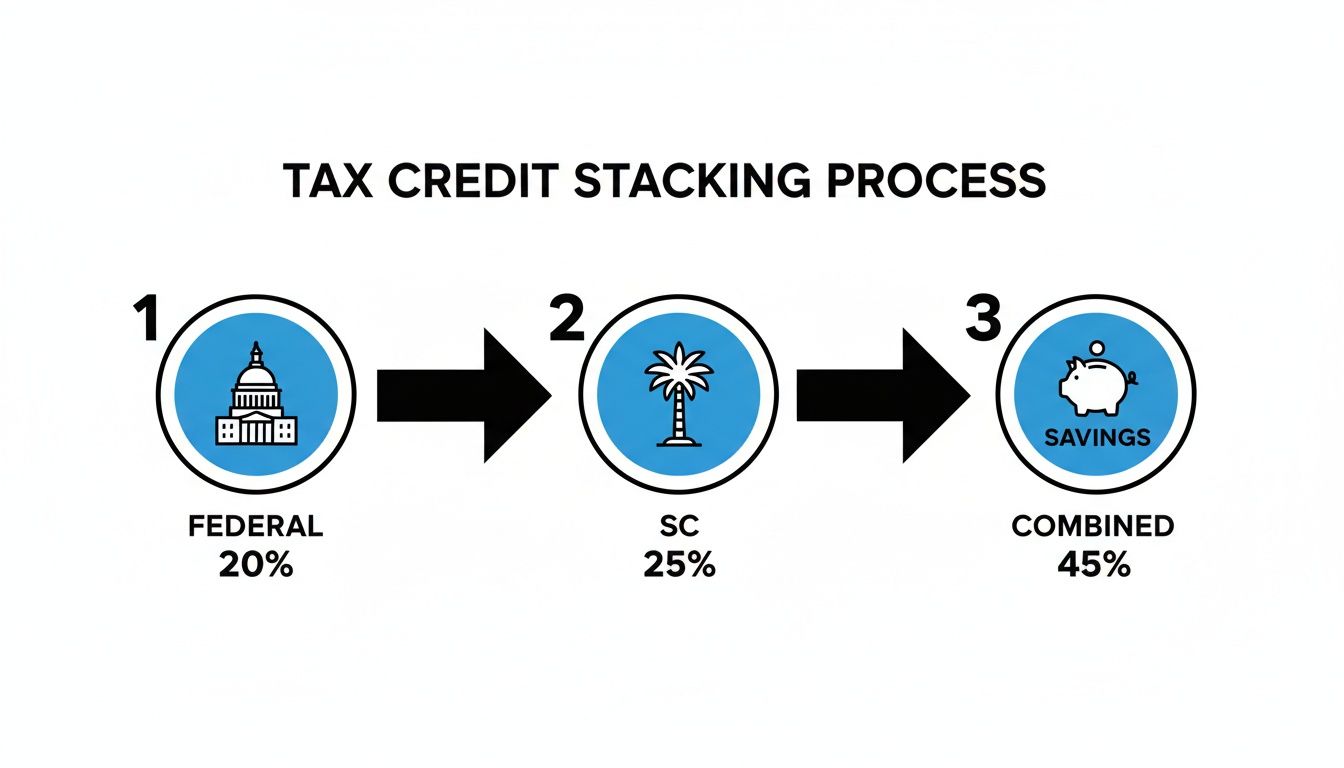
As you can see, combining a 20% federal credit with South Carolina's 25% credit can effectively slash the real cost of a project by nearly half.
Part 3: Certifying the Finished Work
After your Part 2 is approved and all the construction work is finally done, you'll submit the Part 3 application. This is the last step, where you certify that the work was completed exactly as described in your approved plan. You'll submit a complete set of "after" photographs that show off the finished project and prove that every detail adheres to the preservation standards.
Once the SHPO and the National Park Service sign off on Part 3, you get your final certification. This is the official document you’ll need when filing your taxes to claim the historic preservation credits you’ve earned. It’s the finish line of a very meticulous race—and the key that unlocks some serious financial returns.
And these programs have a massive impact. In Fiscal Year 2023 alone, 970 completed projects were certified nationwide, which spurred $8.81 billion in qualified rehabilitation work. Even more telling is that 46% of these certified projects were valued under $1 million, proving these incentives aren't just for big corporations. They are actively helping homeowners and small developers just like you.
How a Design-Build Partner Simplifies Your Project
Let's be honest: navigating the world of historic preservation tax credits can be a nightmare. The paperwork is dense, the architectural rules are incredibly specific, and one small mistake can put your entire financial benefit at risk. This is not a DIY project. It’s a journey you want to take with an expert guide right by your side.
Hiring a design-build firm that specializes in historic properties is the single best move you can make to protect your investment. Instead of you playing traffic cop between an architect, an engineer, and a general contractor, a design-build partner becomes your one, accountable point of contact. It’s an integrated approach that’s practically built for the unique pressures of a historic restoration.
One Team, One Vision
The design-build model brings every part of the project together under one roof. Your team isn't just putting up walls; they're building a convincing case for your tax credits. That means every single decision—from the first rough sketch to the final choice of window hardware—is made with the Secretary of the Interior's Standards front and center.
This unified approach closes the communication gaps that so often cause problems in traditional construction. The architect knows precisely what the construction crew needs to document for the application. The builders understand the "why" behind the preservation rules in the plans. There's no finger-pointing, just a shared mission to deliver a beautiful, compliant restoration. To learn more about this approach, check out the benefits of hiring a design-build contractor on our blog.
Your design-build partner will manage the entire tax credit application lifecycle for you. This includes:
- Initial Documentation: Taking meticulous "before" photos and documenting every inch of your property to build a rock-solid foundation for your Part 1 and Part 2 applications.
- Compliant Design: Drawing up plans that don't just bring your vision to life but also stick to the strict preservation guidelines, paving the way for a smooth SHPO approval.
- Application Management: Preparing and submitting all three parts of the application, handling all the back-and-forth with the SHPO, and responding to any questions they have along the way.
Preventing Costly Pitfalls
One of the biggest fears in a historic tax credit project is having your credits denied after the work is done. This can happen if unapproved changes are made on the fly or if the finished project doesn't perfectly match the approved Part 2 application. An experienced design-build firm is the guardian of your project, ensuring every step stays compliant.
A design-build partner isn't just a builder; they are your project's advocate and compliance manager. Their job is to anticipate challenges, manage the immense documentation required, and protect you from the financial risk of non-compliance, allowing you to focus on the excitement of seeing your historic property brought back to life.
They're the ones who know how to solve tricky problems, like sourcing just the right historically accurate materials or finding skilled craftspeople who understand traditional techniques. If something unexpected comes up during construction—which it often does—they know how to properly amend the plans with the SHPO.
This constant, expert oversight is what separates a successful tax credit project from a financial disaster. By tying design, planning, and construction together, a design-build firm turns a daunting process into a predictable and rewarding one, protecting both your property’s legacy and your bottom line.
Real Restoration Stories from Charleston
Tax credit rules and financial models are one thing, but seeing how they work in the real world is another. The true power of these incentives really shines through in the stories of the homes themselves.
Let's walk through two common scenarios we see all the time in the Charleston area. These examples show just how these credits can turn an ambitious, and often expensive, restoration dream into a financially viable reality.
Case Study One: A Single-Family Home on the Peninsula
Picture a classic Charleston single house, south of Broad Street, that's been in the same family for generations. It’s a beautiful home, but it needs serious work. The foundation has settled over the years, and the original wood windows are weather-beaten and in desperate need of careful restoration. The total estimate comes in at a daunting $180,000.
Because this is the family’s primary residence, the big federal credit is off the table. But that’s not the end of the story. The property was a perfect candidate for South Carolina's 10% owner-occupied credit.
- Project Goal: Complete $180,000 in qualified foundation repairs and window restoration.
- Credit Used: The South Carolina Homeowner Tax Credit.
- Financial Outcome: A $18,000 state tax credit (10% of $180,000).
That $18,000 wasn't just a small discount; it was a direct reduction of the family's state income tax bill. This effectively brought the net cost of the project down to $162,000, making a high-quality restoration possible. It was the difference between honoring the home’s history and being forced to cut corners with cheaper, less authentic alternatives.
This story gets to the heart of it: even if your project doesn't fit the federal program, state-level support can be a game-changer. The owner-occupied credit is absolutely vital for preserving the residential fabric of our historic neighborhoods.
Case Study Two: A Mount Pleasant Property with a Rental Unit
Now, let's head over the bridge to Mount Pleasant's historic Old Village. A homeowner there needed to update their main house, but the real challenge was a dilapidated carriage house out back. The vision was to convert it into a long-term rental unit.
Because this part of the property would produce income, the project unlocked a powerful combination of both federal and state credits. The total cost for the carriage house rehabilitation was $250,000.
- Federal Credit: 20% of $250,000 = $50,000
- State Income-Producing Credit: 25% of $250,000 = $62,500
- Total Combined Credit: $112,500
By stacking these credits, the owner received a staggering $112,500 reduction on their income taxes. This slashed the project's real cost from $250,000 down to just $137,500. An expensive, almost speculative project was suddenly transformed into a smart financial investment that also created a new housing unit and boosted the property's value.
These projects don’t just benefit the homeowner. Research consistently shows that historic tax credit projects lift property values in the surrounding neighborhood, attract new residents, and grow the local tax base. It’s a ripple effect of positive change. And this isn't just a big-city program—a full 29% of certified projects happen in communities with fewer than 50,000 people. You can discover more about the community-wide benefits of preservation and see the economic impact for yourself. These Charleston stories are perfect examples of how these incentives help build vibrant, resilient communities, one restored building at a time.
Answering Your Top Historic Tax Credit Questions
When you start digging into historic tax credits, a lot of practical "what if" questions pop up. Getting these sorted out early on is key to making sure your project runs smoothly and you actually get the financial benefits you're counting on.
One of the biggest questions we hear is about timing and ownership. To keep the full federal tax credit, you have to hold onto the property for five full years after the renovation is officially complete. If you sell before that five-year mark, the IRS can actually claw back the credit, so it’s something you need to plan for from the start.
What Happens When Plans and Costs Change?
It’s natural to wonder if you can save some money by doing the work yourself. Can you claim your own labor? The short answer is no. "Sweat equity" doesn't count as a qualified expense for these programs. The credits are based only on the hard costs you can document—things like payments to your contractor, architect fees, and material purchases.
So, what if your plans change midway through the project after you’ve already been approved? Any major change to the renovation plans has to be officially submitted to the State Historic Preservation Office (SHPO) as an amendment.
This is a big one: you must get the SHPO’s approval on any changes before you do the work. Moving forward without their sign-off could put your entire tax credit at risk.
This is where having an experienced team in your corner is a lifesaver. They can handle the communication with the SHPO to make sure everything stays compliant. For especially tricky projects, it’s often smart to bring in specialized Historic Tax Credit Consultants who live and breathe this stuff.
Tackling a historic restoration and navigating the tax credit maze requires a partner who knows Charleston’s unique landscape inside and out. The team at Citadel Enterprises brings that deep local experience to every project. We guide you from the first sketch to the final certification, ensuring your restoration is not just beautiful but also a smart financial investment.
Ready to start your project with confidence? Reach out to us at https://citadelenterprises.com.